Summary#
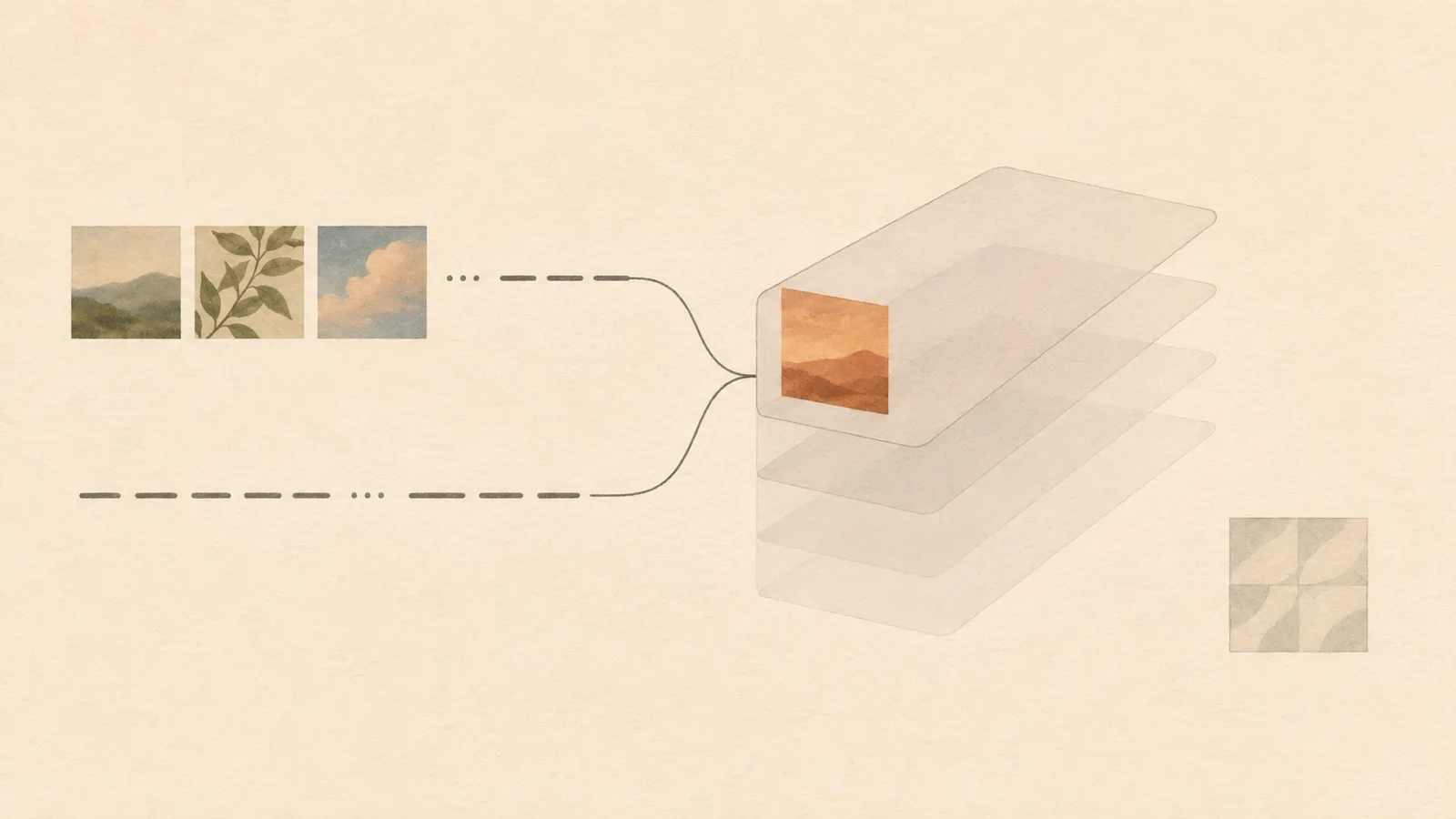
The encoder vs encoder-free debate on Encoder-Free Early Fusion compares recipes that differ in three things at once. Brown, Hoang, Qian et al. (NYU + Meta FAIR; arXiv 2611.17334, 2026-11-12, empirical, 53 pp) split a vision encoder into the three design choices it bundles and test each one separately:
| Recipe | Visual prior | Dedicated capacity | Pre-fusion placement |
|---|---|---|---|
| Pretrained encoder | ✓ | ✓ | ✓ |
| Scratch encoder (trained jointly) | × | ✓ | ✓ |
| Encoder-free (patch embedding) | × | × | × |
| In-fusion (vision-only modules inside the backbone) | × | ✓ | × |
(Table 1 of the paper.) "Dedicated capacity" means parameters that only vision tokens use. The fusion boundary is the first layer where vision and text tokens can interact. Computation before it is pre-fusion, and computation inside the shared backbone is in-fusion.
The verdict, in the authors' four takeaways: the prior is optional, dedicated capacity is key, that capacity can move into the backbone's earliest layers, and all three hold beyond lifetime compute. For recipes that drop the encoder, the authors' advice is to spend its parameter budget as vision-only capacity in the earliest layers rather than as shared parameters.
The protocol: everything from scratch, charged to one budget#
Nothing external is reused. Every model, language backbone included, is trained from random initialization on one data pool: Nemotron-CC v2/v2.1 text and MetaCLIP 1.2 image-text pairs, with captions regenerated by Qwen2.5-VL-32B, mixed 70:30 text to image-text. The backbones are dense Qwen3-shaped decoders at 1.7B and 4B, plus a 0.6B–6.4B ladder. The encoder is a 27-layer, 0.4B ViT shaped like MoonViT-V2, the encoder of Kimi K3. Pretrained variants of the same encoder are pretrained by the authors on the same images. Training is at 224 × 224 (256 vision tokens). Every checkpoint is then instruction-tuned for three epochs on Cambrian-7M at 448 × 448 and scored on the 16 Cambrian VQA benchmarks (Avg. VQA) and 12 text benchmarks (Avg. Text).
The comparison unit is lifetime compute, the FLOPs of every stage that produces the model, encoder pretraining and any text-only pretraining included. Main budgets run from 6.5×10²⁰ to 2.9×10²² FLOPs (56B to 1.11T token-equivalents). The point is that comparisons which count only the multimodal stage treat a pretrained encoder as free. SigLIP 2, for example, trained on 40B image-text samples. §6 then drops that charge to test whether the findings survive.
Finding 1: the prior is optional#
- At matched lifetime compute. At 1.7B and 1.04×10²² FLOPs, encoders pretrained with four objectives (MetaCLIP contrastive, WebSSL self-supervised, Cap and CapPa captioning) are comparable to the from-scratch encoder when pretraining takes 7.4% or 15% of the budget. All four fall clearly below it at a 60% share (Figure 2a). At the 15% share (Table 16, clean against
pdftotext), Avg. VQA is 49.0 for the scratch encoder, 49.3 WebSSL, 48.3 Cap, 47.5 MetaCLIP and 47.2 CapPa, and 45.5 for a frozen MetaCLIP. At 4B the scratch encoder leads every objective: 51.2 against 46.5–48.1. Every pretrained encoder trails the scratch encoder on OCR and chart questions. - Even when pretraining is free (§6.1). With multimodal training fixed at 2.7×10²¹ FLOPs, raising MetaCLIP pretraining from 1.4 to 9.0×10²¹ FLOPs lifts ImageNet linear-probe accuracy from 80.4% to 84.4%. Avg. VQA is nonetheless highest after the shortest pretraining, and an uncharged scratch encoder matches it (Figure 8). A tenth of the learning rate for the pretrained encoder does not recover a benefit either. (Table 18's MetaCLIP block is collapsed in the docling body; these figures come from the §6.1 and Appendix C.3 prose.)
- Recognition does not predict VQA. WebSSL has the lowest ImageNet accuracy of the four objectives (61.5% top-1 against 73.0% for MetaCLIP) and the highest Avg. VQA.
- Delaying vision hurts. Training on text alone for the first 25–75% of the run, with the number of image-text examples held fixed, clearly lowers Avg. VQA. The authors relate this to the "vision laziness" Han et al. (2026) report after text-only training.
Limitation stated by the authors: encoders are pretrained only on the images the multimodal stage also sees. The result therefore says nothing about released encoders trained on additional data.
Finding 2: dedicated capacity is what the encoder buys#
At 1.7B and 2.6×10²¹ FLOPs (Table 2, clean), the scratch encoder scores 44.4 Avg. VQA against 39.0 for encoder-free. Most of the gap is on OCR and charts (38.2 vs 25.2). Avg. Text is a point higher without the encoder (50.7 vs 49.7). The paper rules out three explanations for the VQA gap:
- Fewer total parameters. Giving the encoder-free backbone the encoder's 0.4B as extra width, depth or both leaves Avg. VQA at 38.6–38.8 while Avg. Text rises to 51.2–51.4. At 4B, a wider encoder-free backbone gets 48.1 against the encoder's 51.9 (Table 19). Matching the encoder's token count instead, which gives encoder-free more compute (Table 20, constant learning rate), shared FFNs need about twice the encoder's parameters to catch it: +0.5B reaches 41.1, +0.8B reaches 44.4, against 44.2.
- A weak patch embedding. A Gemma-4-style normalized two-layer projection gains 1.5 points and an Inkling-style four-layer hMLP loses 3.1, so both stay far behind at 224 × 224. Richer embeddings help only when they compress a higher-resolution image into the same 256 tokens. Read at 640 × 640 through 40-pixel patches, the hMLP matches the encoder (40.2 vs 40.2, Table 21), mostly on OCR and charts.
- A too-small encoder. Larger encoders do not help: 0.92B and 1.26B variants score no better than the 0.4B default at 1.7B (Table 5). At 6.4B, keeping the 0.4B encoder is comparable to scaling it to 1.7B (Table 7).
Held-out caption loss is the right proxy, and averaged loss is not. Caption loss on unseen images tracks Avg. VQA along one line across all four recipes (r = −0.96, Figure 18), most closely on OCR and charts.
Why Shukor et al. (2025) found parity#
Shukor et al.'s Scaling Laws for Native Multimodal Models (ICCV 2025, not in the vault) trained both designs from scratch and found encoder-free equal or slightly ahead. Appendix D.4 reproduces that result and traces it to two choices in the setup.
- The encoder's learning rate. Shukor et al. train their encoder at a reduced rate, the best of 0.1×, 0.01× and 0.001×. Most of the encoder's lead disappears between 1× and 0.1×, which their sweep never covers. At the 1B ladder size and 128 TPP (Table 22, clean): 36.3 Avg. VQA at 1×, 32.8 at 0.1×, 31.2 at 0.01×, against 31.0 for encoder-free.
- Averaged validation loss. Averaging text, interleaved and caption losses dilutes the vision signal. At 1.7B and 128 TPP the two designs reach the same averaged loss while the encoder leads by 4.8 Avg. VQA points (Figure 15).
Training on raw alt-text captions also delays the encoder's lead. With both changes, a 0.01× encoder learning rate and alt-text, encoder-free reaches a lower alt-text caption loss at both sizes and every budget, by 0.04–0.07 nats, as Shukor et al. report. The authors conclude that the parity "may reflect an under-trained encoder or an averaged loss that can hide its benefit."
Finding 3: the capacity need not precede fusion#
In-fusion vision capacity adds vision-only modules to selected backbone layers. Each layer keeps its shared weights. A vision-only FFN branch reads the same normalized input as the shared FFN, and vision-only deltas ΔW are added to the Q, K, V and O projections. Both apply only where the token is visual, and their outputs add to the shared ones. The deltas and the branch output projection start at zero, so training begins from the shared model, and text-only inputs pass through exactly as in the plain backbone. Attention stays joint, with no second attention stream. This differs from Mixture-of-Transformers (MoT), where vision tokens use separate weights instead of the shared ones. The parameter budget is matched to the encoder's 0.4B. At 1.7B that is 302M of FFN branch plus 101M of QKVO deltas (Table 23).
Placement is decisive (Table 3, every variant +0.4B at 1.7B, clean):
| Vision-only FFN branch | Avg. VQA | OCR |
|---|---|---|
| Layers 1–8 | 45.0 | 36.0 |
| Every layer (narrow) | 39.4 | 31.3 |
| Spread (8 of 28) | 37.6 | 28.1 |
| Layers 21–28 | 35.1 | 23.3 |
| All-token controls, layers 1–8: shared FFN widening | 40.1 | 29.6 |
| All-token controls, layers 1–8: separate branch used by all tokens | 42.3 | 30.8 |
| Reference: scratch encoder / encoder-free | 44.4 / 39.0 | 38.2 / 25.2 |
Only early placement matches the encoder, and reserving the branch for vision tokens beats giving the same parameters to all tokens. The all-token branch still trails at twice the training (Table 24: 45.4 vs 46.7). Adding vision-only QKVO deltas helps on their own at 4B (+1.8 Avg. VQA [1.0, 2.5] over encoder-free, Table 25) and alongside an FFN branch (+1.1 [0.4, 1.9]). They make up the default "in-fusion" variant.
At the longest budget (1.11T token-equivalents; Table 26, clean), in-fusion is 49.2 against 48.9 for the scratch encoder and 44.8 for encoder-free at 1.7B. At 4B the scores are 54.3, 54.5 and 51.7. Avg. Text is within about a point across all three.
What the layers do (Appendix E.4, Figure 16). In-fusion models change vision tokens mostly inside the eight augmented blocks and little afterward. The encoder-free model keeps changing them through shared blocks 4–13. After the in-fusion blocks, caption tokens attend to vision tokens more than in either other recipe. This is the controlled counterpart of the implicit-encoder finding on Encoder-Free Early Fusion. An encoder-free backbone builds an encoder out of shared layers, and in-fusion gives that early-layer job its own parameters.
It holds with scale: a ~3× compute gap, no crossover#
A ladder of five dense backbones (0.6B, 1B, 1.7B, 3.2B, 6.4B) scales the vision module with the backbone, at about 0.29 of non-embedding parameters (115M → 1.69B). In-fusion occupies the first 29% of depth. Separate laws are fitted per recipe on 17 runs each (Tables 29–31, reconciled against pdftotext -layout):
- Encoder-free needs 2.6–3.1× the encoder's compute on Avg. VQA and 2.4–3.8× on held-out caption loss, read at 64 TPP from 1.7B to 6.4B. On text loss the factor is 1.0. In-fusion needs 1.0–1.1× on VQA and 0.9–1.0× on caption loss.
- The gap does not narrow across the measured range. The largest run, 6.4B at 128 TPP (3.12×10²² lifetime FLOPs), scores 54.6 for the encoder, 54.2 for in-fusion and 49.1 for encoder-free. The fitted Avg. VQA law has a smaller ln D coefficient for encoder-free (4.75 vs 5.25), so the fits predict the gap widens with data rather than closing.
- The laws extrapolate. Laws fitted on 0.6B–3.2B predict the 6.4B runs with a mean absolute Avg. VQA error of 0.95 points. The caption-loss laws predict the separately trained 1.7B and 4B main runs to within 1.6% on average.
Beyond lifetime compute#
- Midtraining from a pretrained LLM (§6.2, Table 33, clean). The authors pretrain a 1.7B text model on 1T tokens, then continue each recipe to 1.33T token-equivalents. Avg. VQA: in-fusion 50.1, scratch encoder 48.6, MoT on layers 1–8 48.5, a free (uncharged) MetaCLIP encoder 43.5, MoT on all layers 43.3 (with 3.5× the vision-only parameters), encoder-free 39.8. Every recipe keeps Avg. Text within a point of a text-only control. The encoder-free deficit is larger here than from scratch (8.8 points against 3.9 for the same recipe trained with vision from the start). The free MetaCLIP trails the scratch encoder most on OCR and charts. The authors' hypothesis is that contrastive features miss fine detail and must be reshaped by a language model that already leans on text. (Table 34, the learning-rate retune, is welded and shifted in the docling body and is cited here only through its prose: retuning narrows MetaCLIP's gap but leaves the ranking.)
- Serving (§6.3, Table 36). Measured on one H200 with 16 concurrent requests, each with a 448-pixel image (1,024 vision tokens) and 256 text tokens. At 1.7B with the 0.4B budget, time to first token is 210 ms with the encoder, 182 ms for in-fusion (−13%), 171 ms for its FFN-only variant (−18%) and 146 ms for encoder-free. The saving grows with the vision budget and the resolution, because a separate encoder is a serial step before prefill. At a fixed budget, vision adds about the same absolute time at 1.7B and 4B. The authors note that under continuous batching of mixed requests, in-fusion's modules run inside forward passes that text-only requests share. A separate encoder delays only image requests.
- Training speed (Table 35). At 4B, the encoder recipe takes 2.9% longer than encoder-free at equal FLOPs ([1.9, 4.2]). Both in-fusion variants are within ±0.3%. The encoder is an unoptimized reference implementation, and a compiled Base encoder trains within 0.2% of a matched in-fusion model.
How it squares with the rest of the vault#
- Against the visual-information-gain study on Encoder-Free Early Fusion (a contradiction). Ge, Li & Qiu conclude the encoder's advantage is "the pretrained prior, not the architecture." Their evidence is a randomly initialized SigLIP 2 architecture that extracts no more layout information than a linear embedding, and they cite Shukor et al.'s parity in support. This paper finds the opposite for the architecture and attributes Shukor's parity to an under-trained encoder. Weighting: both are
empirical. The random-init result is one run at a 158M decoder, stopped at 8.1B tokens under a pre-declared rule. This paper's capacity result spans 0.6B–6.4B, 56B–1.11T token-equivalents, several learning rates and a fitted ladder. For the architecture question, it is the stronger evidence. The two do agree on one point that remains open. VIG's frozen SigLIP 2 was pretrained on far more external data, and that is the case this paper explicitly does not test. - Against Tuna-2's matched 7B result (a contradiction, unresolved). On Encoder-Free Early Fusion, Tuna-2's encoder-free arm beats its SigLIP 2 twin on 10 of 12 understanding benchmarks after about 2T tokens. Here encoder-free trails at every size and budget, from scratch and in midtraining. The setups differ on nearly every axis Tuna-2 varies. Tuna-2 adds a masking objective that helps its encoder-free arm most, co-trains generation, starts from a pretrained 7B, uses an externally pretrained encoder, runs about 3T tokens, and reports no visual-token counts. None of these is isolated (see Open Questions).
- Against the predicted crossover. Chen et al.'s fitted laws put loss parity near 6.1×10²¹ FLOPs, with a ~400M SigLIP 2 encoder held fixed as the MoE decoder grows. This ladder scales a jointly trained encoder with a dense backbone. Encoder-free still trails at measured budgets of 1–3×10²² lifetime FLOPs, and the fitted gap stays near 3×.
- Native Multimodal Modeling: Fusion Depth and I/O Duality. In-fusion does not fit the survey's operators. Its wiring is early-fusion, since patches enter through the same linear embedding as encoder-free (
T), but its parameters are modality-specific, the property the survey assigns to modality-expert designs. It is a narrower version of MoT: additive rather than replacing, and early-layers-only rather than full-depth. The midtraining result says this matters, because all-layer MoT trails layer 1–8 MoT by 5.2 points. The authors name sparse MoE backbones, "whose experts could naturally host in-fusion's modality-routed capacity," as the most compelling next step. That bears on the survey's proposed expert nativity axis. - The deployed models. The paper describes Kimi K3 as training its MoonViT-V2 from scratch jointly with the backbone. That is the recipe this paper finds equal to a pretrained encoder, and it keeps the dedicated capacity this paper finds decisive. The paper also reports that Inkling was released as encoder-free while its successor, Inkling 2 Small, uses a 292M-parameter vision encoder (citing TML's announcement, which is not in the vault). If that holds, the lab that started the encoder-free line on this wiki has itself put dedicated vision capacity back.
Caveats#
- Scale and data. Dense backbones only, at most 6.4B. Training is at 224 × 224 on MetaCLIP web images, with no video, interleaved or text-rich data, and no audio path. The text-image mixture was selected with the scratch encoder at 1.7B, so it may favour that recipe.
- "Comparable" means within about a point. Most rows are single runs, with no seeds or intervals outside Tables 25 and 35. The Avg. VQA numbers are measured after a 448-pixel instruction-tuning stage, which quadruples the vision tokens relative to training.
- COI: the authors include Meta FAIR researchers, and Meta FAIR is also behind Tuna-2. There is no product stake in any arm, and the paper reproduces the rival result it disputes rather than only asserting against it.
Connections#
- Encoder-Free Early Fusion — the debate this page decomposes. The encoder-free recipe here is that page's design, and this paper's ~3× gap and Shukor rebuttal bear on its matched-size, crossover and encoder-scaling questions
- Native Multimodal Modeling: Fusion Depth and I/O Duality — in-fusion is early-fusion wiring with modality-expert parameters, a combination the survey's operators do not name; the MoE extension bears on its expert-nativity question
- Kimi (Moonshot AI) — the from-scratch, jointly trained MoonViT-V2 recipe this paper's encoder is modeled on
- Inkling — the encoder-free line whose successor reportedly adds a 292M encoder; its hMLP patch embedding is one of the variants tested
- Gemma 4 — its normalized two-layer projection is the other patch-embedding variant tested; neither closes the gap at 224 pixels
- Does the Encoder-Free Crossover Arrive, and Does It Survive a Scaled Encoder? — applies this ladder to Chen et al.'s predicted crossover: lifetime accounting favours encoder-free and it still trails past 10²², Table 7 shows encoder share does not matter at 6.4B, and the per-recipe caption-loss floors explain why a faster exponent does not cross
Open Questions#
- Why does Tuna-2's encoder-free 7B beat its encoder twin when this protocol's encoder-free arm never does? The candidates are Tuna-2's masking objective, its generation co-training, its external-data SigLIP 2, its ~3T-token horizon and unreported visual-token counts. Settler: this protocol's 1.7B midtraining comparison rerun with Tuna-2's masking objective on the encoder-free arm, or Tuna-2's pair rerun with a jointly trained scratch encoder.
- Does a released encoder pretrained on extra data (e.g. SigLIP 2's 40B samples) beat a jointly trained scratch encoder at matched multimodal compute? This paper's null covers only same-data priors, while What Does the Visual Encoder Buy? Visual Information Gain in Encoder-Free Multimodal Pretraining finds a frozen SigLIP 2 far ahead of a linear embedding. Settler: this protocol with an external SigLIP 2 checkpoint, charged and uncharged, against the scratch encoder.
Sources#
- Unbundling Multimodal Vision Encoding — Ellis Brown, Chris Hoang (equal contribution), Shengyi Qian, Shang-Wen Li, Mike Lewis, Marjan Ghazvininejad, Luke Zettlemoyer, Lucas Beyer, Mengye Ren, Jakob Verbeek, Saining Xie & Hu Xu (Meta FAIR, NYU), Unbundling Multimodal Vision Encoding, arXiv 2611.17334 v1, 2026-11-12, 53 pp (
empirical). §2 + Table 1 + Appendix A the protocol and lifetime compute, §3 + Figure 2 + Table 16 the pretraining comparison, §4 + Tables 2, 19–21 dedicated capacity, Appendix D.4 + Table 22 + Figure 15 the Shukor comparison, §5 + Tables 3, 23–26 + Figure 16 in-fusion, §5.4 + Appendix G + Tables 28–32 + Figure 7 the scaling ladder, §6 + Tables 33, 35–36 + Figures 8–10 midtraining and speed, §8 limitations. Parse warning, in this page's convention: the ingest verify flagged table-collapse (721 cells), table-shift (23) and table-weld (21), and five formulas were left undecoded (the lifetime-compute sum, the in-fusion projection and FFN equations, the encoder and patch-embedding maps; their meaning is stated in prose). Table 18's MetaCLIP pretraining-sweep rows are collapsed (four FLOP values in one cell) and Table 34's MoT and MetaCLIP rows are welded and shifted, so both are cited only through their prose. Tables 2, 3, 16, 20–22, 26, 29, 30 and 33 were reconciled againstpdftotext -layouton the local PDF, and every cited cell matches. Figures 2 and 7 were viewed; the "≈3× the compute" annotation and the 2.9× arrows are the figure's own.
Cited by 7
- Encoder-Free Early Fusion×6
Encoder-free wins 10 of 12 at matched backbone and matched data, while being the smaller model and…
- Does the Encoder-Free Crossover Arrive, and Does It Survive a Scaled Encoder?×4
unbundling multimodal vision encoding (Brown, Hoang et al.) trains every recipe from scratch on one…
- Inkling×3
Encoder-free multimodality: audio in as dMel spectrograms, images as 40×40-pixel patches through a…
- Kimi (Moonshot AI)×3
A controlled from-scratch study then comes down on K3's side (2026-11-24). unbundling multimodal…
- Native Multimodal Modeling: Fusion Depth and I/O Duality×3
Is "expert nativity" — how far MoE experts are jointly trained across modalities versus specialized…
- Interaction & Multimodal
Vision Encoder Unbundling — A vision encoder bundles three separable choices: a visual prior from…
- Open Questions Backlog
Vision Encoder Unbundling ×2 (oldest 0d) — Why does Tuna-2's encoder-free 7B beat its encoder twin…
Related articles
- Encoder-Free Early Fusion
Multimodal design with minimal pre-processing instead of large standalone encoders: TML co-trains dMel audio + 40×40-pa…
- Interaction / Background Model Split
Dual-model architecture: a time-aware interaction model stays present while an async background model handles deep reas…
- Inference Efficiency as Capability
If capability is a function of inference budget, then cutting the cost of a token is capability work: Gemma 4's five le…
- Interaction Models
Thinking Machines Lab (May 2026): models that handle audio/video/text interaction natively in real time instead of via…
- The Open-Weight Frontier Gap
How far open weights trail the closed frontier, on several axes. Arena Text (June 2026): 33 Elo to the best open model,…