Sources#
- Gemma 4 Technical Report
- Inkling: Our Open-Weights Model
- Interaction Models: A Scalable Approach to Human-AI Collaboration
- Kimi K3 Model Card
- Toward Native Multimodal Modeling: A Roadmap
- Tuna-2: Pixel Embeddings Beat Vision Encoders for Multimodal Understanding and Generation
Summary#
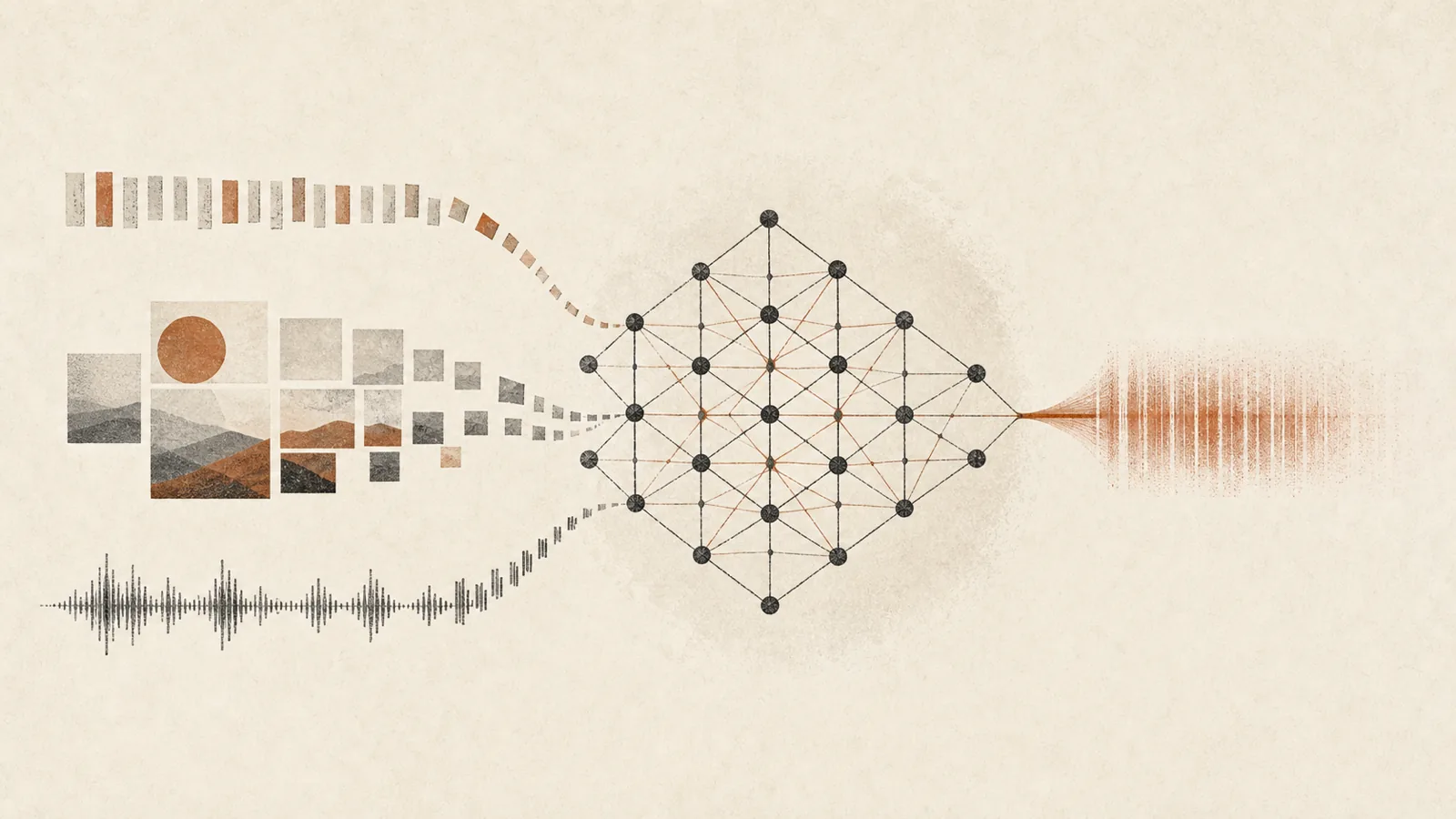
A multimodal-design choice in Interaction Models: instead of routing audio and video through large, standalone encoders (and audio out through a separate TTS-like decoder), use minimal pre-processing and a single transformer with all components co-trained from scratch. "Encoder-free" is relative — there are light embedding layers — but there's no Whisper-scale audio encoder or separate TTS model.
The components (one 200ms micro-turn)#
Inputs (any subset of text / frame / audio):
- Text → token embedding (standard).
- Image / video frame → split into 40×40 patches, encoded by an hMLP (Touvron et al. 2022).
- Audio → taken in as dMel (Bai et al. 2024), transformed by a light-weight embedding layer ("bag of embeddings").
Single shared Transformer consumes the fused inputs.
Outputs:
- Text → unembedding (standard).
- Audio → a flow head (Lipman et al. 2022) producing mel.
All components are co-trained from scratch together with the transformer — not stitched from pretrained encoders/decoders.
Why this matters#
- Avoids the latency and complexity of large standalone encoders/decoders — important when you have to do this every 200ms (see Time-Aligned Micro-Turns).
- Early fusion (everything into one transformer) means the model reasons jointly over modalities rather than over pre-digested encoder outputs — a prerequisite for things like reacting to a visual cue while speaking (see Full-Duplex Interaction).
- Co-training from scratch is consistent with The Bitter Lesson: fewer hand-engineered modular boundaries, more learned-end-to-end.
Independent corroboration: Gemma 4 12B (July 2026)#
The design above rested on a single source and a single lab. Gemma 4 (empirical) arrives at the same architecture from an unrelated starting point — and this is the more interesting kind of agreement, because the motivation differs.
TML removed encoders to hit a 200 ms latency budget. DeepMind removed them for memory: "alleviating the need for separate encoders and reducing memory fragmentation" on edge hardware. Same verdict, orthogonal reasons. When two labs optimizing different objectives converge on deleting the same component, the component was probably not load-bearing.
The Gemma 4 12B implementation:
- Vision. 48×48×3 RGB patches through a single 35M matmul, replacing a 550M ViT. 2D coordinate-based positional embeddings are added to patch representations before a final LayerNorm.
- Audio. The 305M USM-based conformer is entirely discarded. Raw 16 kHz audio is segmented into 40 ms chunks — 640-dimensional vectors — and projected directly into the LLM embedding space. No positional encoding is added at all: audio is already a temporal sequence.
Table 8 is the receipt. The encoder-free 12B reaches 0.063 WER on English FLEURS ASR and 41.9 CorpusBLEU on CoVoST de→en, against the encoder-having E4B's 0.065 and 42.0. Throwing away a 305M conformer cost, on those numbers, nothing. DeepMind's own caption: "competitive audio-text performance can be achieved without a dedicated audio encoder."
Two caveats the report doesn't state#
It is not a controlled ablation. The encoder-free model is the 12B; the encoder-having comparison is the 4.5B-effective E4B. The 12B has more LLM capacity to absorb the work the discarded encoder used to do. The claim "competitive performance is achievable without an encoder" is supported. The stronger claim "removing the encoder is free" is not tested anywhere in the paper — a same-size arm would settle it, and none is run. (The same-size arm now exists, from a different lab and for vision only — see the Tuna-2 section below. Its verdict is stronger than "free": at 7B the encoder-free arm is better on understanding and worse on generation.)
There is a measured regression, and it is specific. Cut vision tokens from 1120 (Table 6) to 280 (Table 12) and the 12B degrades out of order with scale:
| Model | InfographicVQA Δ | OmniDocBench 1.5 Δ (↓ better) |
|---|---|---|
| 31B | −9.2 | +0.070 |
| 26B-A4B | −11.5 | +0.120 |
| 12B (encoder-free) | −29.7 | +0.244 |
| E4B | −15.2 | +0.126 |
| E2B | −19.3 | +0.206 |
The 12B falls harder than models both larger and smaller than it — the only ordering violation in the family, and it is the only encoder-free member. The effect is confined to dense-text-in-image tasks: MMMU Pro (−1.4) and MATH-Vision (−3.0) degrade normally. A plausible reading is that a 35M linear projection performs no feature compression, so the model must spend resolution where a ViT would have spent parameters. Reading small text then becomes token-budget-bound.
If that reading is right, encoder-free is not free — it trades encoder parameters for vision tokens, which is an inference-cost trade, not a saving. The report neither reports nor comments on the inversion. (Partly superseded 2026-09-21 by Tuna-2: Pixel Embeddings Beat Vision Encoders for Multimodal Understanding and Generation: the matched 7B ablation shows a projection-only path leading on OCRBench, so dense text does not require an encoder. The parameters-for-tokens reading survives as the reason the Gemma 4 cliff appeared at 280 tokens specifically — Tuna-2 never sweeps its token budget, so the mechanism is untested either way. What it does establish is a different non-free-ness: the encoder-free arm needs an added masking objective, and loses outright below ~2T tokens or on a 1.5B backbone.)
Third instance: Inkling at 975B (July 2026)#
Inkling (vendor-claim) carries the design from a 276B research preview and a 12B edge model to a 975B open-weights foundation model: audio as dMel spectrograms, images as 40×40-pixel patches through a four-layer hMLP, both via lightweight embedding layers "processed jointly with text tokens," trained from scratch on general-domain data — TML explicitly calls the choice "consistent with the interaction model design." Same lab as instance one, so it is scale-transfer rather than fresh corroboration, but it answers a question the first two instances left open: whether encoder-free inputs hold up when the budget allows any architecture. TML reports Inkling among the strongest open-weights audio models (VoiceBench 91.4, MMAU 77.2, AudioMC 56.6 vs 24–38 for the open omni specialists it compares) and strong chart/diagram vision (CharXiv RQ 78.1). Still no matched-size encoder/encoder-free ablation from any of the three instances — the open question below stands.
Counter-instance: Kimi K3 keeps its encoder at 2.8T (July 2026)#
Three instances agreed; the fourth data point disagrees, and it is the largest model of the four. Kimi K3 (vendor-claim) is a 2.8T/104B open MoE with a 401M MoonViT-V2 vision encoder — a dedicated, standalone vision tower, deliberately retained at a scale where nothing forced the choice. It is not an edge model with a memory ceiling and not a latency-bound interaction model; Moonshot had the budget for any architecture and picked the one this page documents labs abandoning.
The comparison that matters is where it wins. The encoder-free 12B's one measured regression was dense text in images — a −29.7 InfographicVQA cliff and the family's only scale-ordering violation — with the proposed explanation that a projection-only path performs no feature compression, so resolution must substitute for parameters. K3 is the strongest model in this corpus on precisely that task family: OmniDocBench 91.1, the top cell in its own 45-model-pair table (ahead of Fable 5's 89.8), and OfficeQA Pro 63.3 on a setup where "each test case provides the agent with the entire PDF corpus, with all PDFs rendered as images and no machine-readable text available." Meanwhile it trails Fable 5 on the perception-and-reasoning vision benchmarks (WorldVQA 51.0 vs 56.7, BabyVision 85.7 vs 90.5, CharXiv 84.8 vs 88.9) — the inverse of the profile you would predict if the encoder were simply general vision capacity.
How much this should move you: not far, and the reason is worth stating rather than resolving. This is not the matched-size ablation the first open question below asks for; it is a different lab, a different scale, a different training corpus, and a vendor's own numbers. Nothing here shows that removing MoonViT-V2 would cost K3 anything, and nothing in the Gemma 4 data shows that adding an encoder would have saved its 12B. What the four instances jointly establish is narrower and more useful than "encoder-free wins": at the ~1T frontier the field has not converged. TML dropped the encoder at 975B and Moonshot kept one at 2.8T, in the same month, both reporting strong vision. Treat "encoder-free is the trend" as a two-lab observation (TML and DeepMind), not a field verdict.
One asymmetry does survive the caveats: every encoder-free instance here also drops the audio encoder, and K3 has no audio path at all (text and image only). The strongest evidence for encoder-free — Gemma 4's Table 8, where discarding a 305M conformer cost 0.002 WER — is audio evidence, and K3 does not contest it.
The matched-size arm finally exists: Tuna-2 vs Tuna-R at 7B (April 2026)#
Every instance above compares an encoder-free model to a different model — different scale, different lab, or different training run. Tuna-2 (Liu et al., Meta FAIR + HKU + Waterloo, arXiv 2604.24763, empirical) is the first source in this corpus to run the arm the open questions below have been asking for: two unified multimodal models that differ only in whether a pretrained vision encoder sits in the visual path.
- Tuna-R — Qwen2.5-7B-Instruct decoder + SigLIP 2 So400M representation encoder + connector (the LLaVA shape, with the VAE already removed).
- Tuna-2 — the same Qwen2.5-7B-Instruct decoder, a single patch-embedding layer at patch size 16 on raw pixels, and nothing else. No VAE, no representation encoder, one transformer.
Both do understanding and pixel-space image generation (rectified-flow, JiT-style x-prediction with a v-loss), so a single ablation covers both halves of the design.
What is matched. Stage-1 pretraining: the same 550M in-house image–text pairs at a 7:3 generation-to-understanding sampling ratio (7g3u, itself chosen by ablation), plus Nemotron text at 20% of the mix; 300k steps on 64 nodes, AdamW at 1×10⁻⁴, sequences padded to 16k tokens per GPU; the masking objective over the final 40% of pretraining (50% of examples, mask ratio sampled 0–50%). Stage-2 SFT: the same corpus (13M FineVision conversations + ~2M OmniEdit edits), 50k steps at 2×10⁻⁵. Same benchmark suite, same protocol.
What is not matched — and all three asymmetries favour the encoder arm.
- Tuna-R carries ~400M extra parameters (SigLIP 2 So400M) plus a connector. Both rows are labelled "7B"; the encoder-free model is the smaller of the two.
- Tuna-R gets an extra training stage Tuna-2 does not: 3k connector-alignment steps at 5×10⁻⁴ before Stage 1. The paper's framing is that the encoder-free design "does not require this additional stage."
- Compute is matched in steps, not FLOPs or visual tokens. Neither arm's visual token count is reported, and a patch-16 pixel path and a SigLIP path do not yield the same sequence length. "Matched size" here means matched backbone and matched data, not matched compute.
A fourth limit is worth stating before reading the table: the Tuna row is cited to the earlier paper rather than presented as a re-run, so only the Tuna-R ↔ Tuna-2 pair is a clean controlled comparison. Tuna is a reference point, not a third arm.
Result (Table 1; every value recovered from pdftotext -f 6 -layout — the docling parse dropped these rows entirely, see the parse warning in Sources).
| Benchmark | Tuna (VAE + enc.) | Tuna-R (enc.) | Tuna-2 (encoder-free) | Δ vs Tuna-R |
|---|---|---|---|---|
| GQA | 63.9 | 63.5 | 65.0 | +1.5 |
| RealWorldQA | 66.1 | 67.9 | 67.7 | −0.2 |
| MMVet | 42.9 | 46.7 | 51.7 | +5.0 |
| MMMU | 49.8 | 51.1 | 50.7 | −0.4 |
| MMVP | 70.7 | 74.7 | 77.3 | +2.6 |
| SEED-Bench2+ | 52.7 | 58.4 | 61.1 | +2.7 |
| AI2D | 79.3 | 79.4 | 79.6 | +0.2 |
| ChartQA | 85.8 | 85.6 | 85.6 | 0.0 |
| OCRBench | 74.3 | 78.3 | 79.7 | +1.4 |
| V* | 52.4 | 57.6 | 59.2 | +1.6 |
| CountBench | 73.5 | 77.8 | 81.7 | +3.9 |
| VisuLogic | 22.4 | 26.2 | 28.8 | +2.6 |
Encoder-free wins 10 of 12 at matched backbone and matched data, while being the smaller model and getting one training stage fewer. The two losses are 0.2 and 0.4 points. The largest gains are exactly where the abstract says they are — fine-grained perception (MMVet +5.0, CountBench +3.9, SEED-Bench2+ +2.7, MMVP +2.6).
The dense-text prediction does not reproduce. The Gemma 4 section above predicted that a projection-only vision path should show the InfographicVQA cliff intrinsically. In the matched comparison the encoder-free arm is best or tied on every dense-text row: OCRBench 79.7 vs 78.3, AI2D 79.6 vs 79.4, ChartQA 85.6 vs 85.6. Two caveats keep this from being a clean refutation. The suite contains no InfographicVQA, DocVQA or OmniDocBench — the exact benchmarks where Gemma 4's 12B fell — and, more importantly, no vision-token sweep: Gemma 4's −29.7 appeared only when tokens were cut 1120 → 280, and Tuna-2 runs at one token budget throughout. So what dies is the strong reading ("projection-only paths are inherently bad at dense text"); the token-budget mechanism this page proposed is untouched, and untested.
Generation is the other direction, consistently. The encoder helps where semantic priors help:
- GenEval overall: Tuna 0.90 / Tuna-R 0.88 / Tuna-2 0.87. DPG-Bench overall: 86.76 / 86.35 / 86.54.
- ImgEdit total: Tuna 4.31 / Tuna-R 4.18 / Tuna-2 4.09 — encoder-free is last of the three.
- LLM-judge best-of-three on 1.5K prompts × 4 images (Table 3): on quality Tuna-2 trails Tuna-R under both judges (GPT-5.4 32.1% vs 35.7%; Claude Opus 4.7 34.8% vs 37.2%), but on diversity it is preferred by a wide margin (48.4% vs 30.9%; 41.9% vs 29.9%).
- Image reconstruction after a light finetune (ImageNet val): Tuna-R rFID 0.12 / PSNR 32.22, Tuna-2 rFID 0.15 / PSNR 32.80, both SSIM 0.93 — first among unified tokenizers, approaching FLUX.1[dev]'s VAE (0.06 / 33.65 / 0.93) without a VAE at all.
"At scale" means training scale, not model scale — and the small-scale arm reverses the verdict. Figure 6 plots accuracy against train tokens, 0T → 3T. Tuna-R leads throughout the early phase on all three understanding benchmarks; the crossover on OCRBench sits at roughly 2T tokens (Tuna-R ~71.5 → 71.5, Tuna-2 ~65.7 → 73.2 over the 1T→3T span), with V* similar and MMVP crossing somewhat earlier. On GenEval Tuna-R leads for the entire pretraining run and the two converge only after SFT. The mirror image is Table 6's ablation on a Qwen-2.5-Instruct-1.5B backbone at 100k steps, where encoder-free loses everything: OCRBench 56.8 vs 59.2, MMVP 55.7 vs 58.0, CountBench 57.6 vs 58.2, GenEval 48.2 vs 56.0. So the finding is not "encoder-free wins"; it is "encoder-free wins given a large-enough backbone and enough pretraining tokens, and loses below that." The encoder buys sample efficiency, and the purchase depreciates.
The masking objective is load-bearing for the encoder-free arm specifically. Same Table 6, masking on vs off: Tuna-R gains +0.9 / +1.3 / +1.0 / +0.3 (OCRBench / MMVP / CountBench / GenEval); Tuna-2 gains +1.4 / +3.4 / +4.2 / +0.6. The authors' explanation is that SigLIP 2 was already pretrained with a masked-prediction objective, so Tuna-R has it baked in. Practical reading: removing the encoder does not come for free — it comes with an added training objective that recovers part of what the encoder supplied.
A calibration the paper's "state-of-the-art" framing obscures. The claim is SOTA among ≤13B native unified models, not among 7B multimodal models. In Table 1's own rows, understanding-only Qwen2.5-VL 7B beats Tuna-2 on 8 of the 12 benchmarks (OCRBench 83.7 vs 79.7, V* 71.2 vs 59.2, MMMU 58.6 vs 50.7, MMVet 61.7 vs 51.7, SEED-Bench2+ 70.5 vs 61.1, AI2D 82.7 vs 79.6, RealWorldQA 69.9 vs 67.7, MMVP 78.0 vs 77.3), with Tuna-2 ahead only on GQA, ChartQA, CountBench and VisuLogic. Dropping the encoder helps within the unified-model design; it does not make a unified model the best way to read an image.
What this settles for the pages above. It is a vision-only, image-only result: there is no audio path anywhere in Tuna-2, so the strongest existing evidence for encoder-free (Gemma 4's audio Table 8) is neither corroborated nor contested. It is also at 7B, not the ~1T scale where TML and Moonshot disagree. And both arms start from a pretrained text LLM, not from scratch — which is precisely what makes it decisive for the third question below.
A definition arrives, and it splits this page's title in two (May 2026)#
An, Lu, Dong et al. (Tencent Youtu Lab + 5 universities, arXiv 2605.25343, practitioner-opinion) is the first source in this corpus to define "native" formally rather than by example — and the definition does not line up with the way this page has been using "early fusion."
The survey's axis is where the tokenization happens, not whether an encoder exists:
- Mid-fusion —
Backbone(C(E₁(m₁), …, Eₙ(mₙ))), encoder features injected into the backbone's intermediate layers through a cross-attention or adapter operatorC. Modality-aware, encoders architecturally distinct from the backbone. Trainability is irrelevant to the classification: a mid-fusion model with a fully unfrozen encoder is still mid-fusion. - Early-fusion —
Transformer(⋃ᵢ T(mᵢ)), one unified tokenization operatorTmapping every modality into a single shared space from the outset.
Encoder-free modeling does not name either regime in the survey. It appears two levels down: one of two strategies (beside "Physical Decoupling" — Janus-Pro's separate understanding/generation encoders, BAGEL's Mixture-of-Transformer-Experts) for resolving the Comprehension-Generation Dilemma inside the M2M Modality-Specificity Preserving camp, with Tuna-2 and SenseNova-U1 as its named instances. Under that reading, this page has been running two claims under one heading: drop the encoder (a parameter-allocation choice, which is what every section above actually measures) and fuse early (a tokenization-path choice, which none of them isolate). T can perfectly well be a learned discrete tokenizer, and Chameleon/AnyGPT/Emu3.5 are the survey's canonical early-fusion models precisely because of their codebooks — the opposite end of the design space from a raw patch projection. Take this as a definitional sharpening, not a finding; the survey measures nothing.
Two absences in the survey are worth recording, because it is a census. Its Gemma-4 rows are 31B and E4B, and it files Gemma-4-31B under Vision-Encoder-Based Fusion — the 12B that carries this page's strongest evidence, the one that discards the 305M conformer, is not in Table 1 or the taxonomy figure at all. So the survey neither corroborates nor contests the Gemma 4 audio result; it catalogues a different part of the family. Nothing from the interaction-model line is present either (TML-Interaction-Small, Inkling), since the census is limited to open-source models and technical reports with "verified architecture and parameter transparency."
One thing the survey does add on the merits: its Table 1 records Tuna-2 as continuous (no discrete-unified star), which is consistent with the matched-arm result above and rules out the reading that Tuna-2's win came from quantization rather than from encoder removal.
Connections#
- Native Multimodal Modeling: Fusion Depth and I/O Duality — the formal definition that separates early-fusion (one tokenizer into one space) from encoder-free modeling (a strategy inside M2M modality-specificity-preserving), and whose census omits the encoder-free Gemma-4 12B
- Interaction Models — parent concept
- Time-Aligned Micro-Turns — why minimal pre-processing is a hard requirement (200ms budget)
- Interaction / Background Model Split — the other half of the architecture
- Full-Duplex Interaction — joint multimodal reasoning is what makes visual+audio interjection possible
- The Bitter Lesson — "co-train from scratch, drop the modular encoders" is a bitter-lesson move
- TML-Interaction-Small — the model that implements this design (dMel audio, 40×40 hMLP patches, flow head), co-trained from scratch
- Gemma 4 — the second, independent instance: a 12B open-weight model that discards its 305M audio conformer outright
- Inkling — the third instance: the design at 975B open-weight scale, chosen for interaction-model consistency
- Inference Efficiency as Capability — memory, not latency, is DeepMind's motivation; and the dense-text regression suggests the saving is really a parameters-for-tokens trade
- The Open-Weight Frontier Gap — encoder removal is one of the levers that lets a small dense model compete at all
- Kimi (Moonshot AI) — the counter-instance: a 401M MoonViT-V2 encoder retained at 2.8T, leading the corpus on the dense-text-in-image tasks where the encoder-free 12B regressed
Open Questions#
- Does an encoder-free model at matched size still match? TML co-trains everything from scratch; Gemma 4 freezes encoders on four models and drops them on one, at a different scale; Kimi K3 retains a 401M encoder at 2.8T and leads on dense-text vision. Partially answered (2026-09-21) by Tuna-2: Pixel Embeddings Beat Vision Encoders for Multimodal Understanding and Generation: for vision, at 7B, on a matched backbone (Qwen2.5-7B-Instruct) and matched data, the encoder-free arm does better than match — it wins 10 of 12 understanding benchmarks against its encoder-carrying twin (MMVet +5.0, CountBench +3.9, OCRBench +1.4) while being ~400M parameters smaller and training one stage fewer, and loses only RealWorldQA (−0.2) and MMMU (−0.4). Three reasons it stays open. The ablation is image-only — Tuna-2 has no audio path, and the audio arm is where the original evidence (a 305M conformer deleted for 0.002 WER) actually lives. It is at 7B, an order of magnitude below the scale where the two labs disagree. And the encoder arm still wins generation (GenEval 0.88 vs 0.87, ImgEdit 4.18 vs 4.09, LLM-judge quality under both judges), so "match" holds for understanding and not for synthesis.
- Is the dense-text degradation intrinsic to a projection-only vision path, or an artifact of the 12B's particular training run? The prediction is falsifiable: an encoder-free 31B should show the same InfographicVQA cliff at 280 tokens. Partially answered (2026-09-21) by Tuna-2: Pixel Embeddings Beat Vision Encoders for Multimodal Understanding and Generation, graded in three parts. Right: the question was right to doubt that the cliff is a property of the 12B's run alone and to treat the vision path's representation as the variable — the matched 7B comparison isolates exactly that variable and produces a clean signal. Wrong: the "intrinsic to projection-only" horn. A patch-16 projection-only path is best or tied on every dense-text row against its encoder twin (OCRBench 79.7 vs 78.3, AI2D 79.6 vs 79.4, ChartQA 85.6 vs 85.6), so nothing about reading dense text requires an encoder. Right for the wrong reason: this page's own proposed mechanism — a projection performs no feature compression, so resolution must substitute for parameters, making dense text token-budget-bound — survives untouched, because Tuna-2 runs at a single token budget and never sweeps it, and its suite contains no InfographicVQA, DocVQA or OmniDocBench. The falsifier that would settle it is now narrower and cheaper: a vision-token sweep on any encoder-free model, not a 31B.
Resolved Questions#
- TML deletes encoders and co-trains from scratch. Gemma 4 deletes encoders and trains the 12B from scratch, but keeps frozen encoders elsewhere. Which half of "encoder-free + from-scratch" does the work? Answered (2026-09-21): the encoder-free half, at least for the vision path — and the two halves are separable. Tuna-2: Pixel Embeddings Beat Vision Encoders for Multimodal Understanding and Generation initializes both arms from a pretrained text LLM (Qwen2.5-7B-Instruct), so nothing in it is trained from scratch, and the encoder-free arm still beats its encoder-carrying twin on 10 of 12 understanding benchmarks. From-scratch co-training is therefore not a precondition for the encoder-free advantage. Two riders that do not reopen the question but bound it: the advantage is conditional on scale, reversing completely on a 1.5B backbone at 100k steps (OCRBench 56.8 vs 59.2, GenEval 48.2 vs 56.0) and appearing only after roughly 2T of 3T pretraining tokens; and removing the encoder is paid for with an added masking objective, which is worth +1.4/+3.4/+4.2 to the encoder-free arm against +0.9/+1.3/+1.0 to the encoder arm.
Sources#
- Interaction Models: A Scalable Approach to Human-AI Collaboration
- Gemma 4 Technical Report — §2.3 (encoder-free architecture), Table 8 (audio without an encoder), Tables 6 & 12 (the 280-vs-1120 vision-token regression) (
empirical) - Inkling: Our Open-Weights Model — dMel + 4-layer hMLP at 975B, from-scratch general-domain training, audio/vision benchmark tables (
vendor-claim) - Kimi K3 Model Card — §2 spec table (MoonViT-V2, 401M, at 2.8T/104B; modality text+image), §3 vision rows (OmniDocBench 91.1, WorldVQA, CharXiv, BabyVision) and footnote 3 (OfficeQA Pro's images-only PDF corpus) (
vendor-claim) — the counter-instance - Tuna-2: Pixel Embeddings Beat Vision Encoders for Multimodal Understanding and Generation — Liu et al. (Meta FAIR + HKU + Waterloo; arXiv 2604.24763, v1 2026-04-27, PDF v2 2026-05-18;
empirical) — the matched-size arm. §2.1 the three-architecture ladder (Tuna → Tuna-R → Tuna-2), §2.2 the masking objective, §3.1 the training recipe both arms share and the two places they differ (SigLIP 2 So400M; the 3k-step connector-alignment stage), §3.2 + Table 1 the 12-benchmark understanding comparison, Tables 2–5 generation/editing/reconstruction, §3.4 + Table 6 the 1.5B masking ablation, §3.5 + Figure 6 the 0T→3T training-scale curves. Parse warning, in this page's convention: the docling parse of Table 1 lost the Tuna / Tuna-R / Tuna-2 rows outright and collapsed the LLaVA/Qwen baseline group into a single multi-value row (25 flagged cells) — every Table 1 and Table 2 number on this page was recovered frompdftotext -f 6 -l 7 -layouton the local PDF, and Tables 3–6 were re-read the same way and match the docling body cell-for-cell. Figures 1, 5 and 6 were viewed; Figure 6's crossover points are read off the plot, not from prose. COI: vendor-adjacent — Meta authors constructing the encoder-based foil they then beat, self-reported, single seed, no error bars; the comparative baselines in Table 1 are copied from their original papers - Toward Native Multimodal Modeling: A Roadmap — An, Lu, Dong et al. (Tencent Youtu Lab + Tsinghua/HKU/Warwick/Monash/PolyU; arXiv 2605.25343, 2026-05-25;
practitioner-opinion, 52 pp): §2.1 the mid-fusion/early-fusion operator definitions, §3.3.2 encoder-free modeling as one strategy inside M2M modality-specificity-preserving, Table 1's Gemma-4-31B/E4B rows and Tuna-2's unstarred (continuous) classification, Figure 4's placement of Tuna-2 and SenseNova-U1. Read here for the definition only — the survey runs no experiments and restates third-party results throughout. Full treatment on Native Multimodal Modeling: Fusion Depth and I/O Duality
Cited by 15
- Gemma 4×3
Encoder Free Early Fusion — Gemma 4 12B is the second independent instance of the design, and the…
- The Bitter Lesson×3
Encoder Free Early Fusion — co-train all modality components from scratch in one transformer rather…
- Google DeepMind×2
Gemma 4's 12B is also the second independent instance of Encoder Free Early Fusion, arrived at for…
- Inference Efficiency as Capability×2
5. Removing the encoders. The 12B's 550M vision encoder becomes a 35M matmul and its 305M audio…
- Inkling×2
Encoder-free multimodality: audio in as dMel spectrograms, images as 40×40-pixel patches through a…
- Interaction Models×2
Time Aligned Micro Turns, Interaction Background Model Split, Encoder Free Early Fusion — the three…
- Kimi (Moonshot AI)×2
K3 ships a 401M MoonViT-V2 vision encoder at 2.8T scale. Encoder Free Early Fusion documents three…
- Native Multimodal Modeling: Fusion Depth and I/O Duality×2
The vault reached "early fusion" from the interaction-model side and had been using it loosely as a…
- Open Questions Backlog×2
Encoder Free Early Fusion: Is the dense-text degradation intrinsic to a projection-only vision…
- TML-Interaction-Small×2
Modalities: continuous audio + video + text in; text + audio out. Encoder Free Early Fusion (dMel…
- Full-Duplex Interaction
Encoder Free Early Fusion — joint multimodal reasoning is what lets a visual change trigger speech
- Interaction / Background Model Split
Encoder Free Early Fusion — the other half of the architecture (the perception/generation side)
- Interaction & Multimodal
Encoder Free Early Fusion — Multimodal design with minimal pre-processing instead of large…
- The Open-Weight Frontier Gap
Encoder Free Early Fusion — one of the levers that lets a 31B dense model contend at all
- Time-Aligned Micro-Turns
Encoder Free Early Fusion — the complementary "minimal pre-processing" choice that makes streaming…
Related articles
- Interaction Models
Thinking Machines Lab (May 2026): models that handle audio/video/text interaction natively in real time instead of via…
- Interaction / Background Model Split
Dual-model architecture: a time-aware interaction model stays present while an async background model handles deep reas…
- Gemma 4
Google DeepMind's July 2026 open-weight multimodal family (Apache 2.0): 2.3B–31B dense plus a 26B/4B-active MoE, adding…
- Inkling
Thinking Machines Lab's first from-scratch open-weights family (July 2026): a 975B/41B-active multimodal MoE with 1M co…
- Native Multimodal Modeling: Fusion Depth and I/O Duality
An, Lu, Dong et al. (Tencent Youtu + 5 universities, May 2026) formalize 'native' as two operator definitions — mid-fus…