Question#
How do the wiki's product-development concepts — Prototype Over PRD, Building Is Cheap, Arguing Is Expensive, Design Concept Grilling, and the lighter-PRD practice in AI Native Product Cadence — fit together into a single spectrum of PRD-replacement at AI-native speed?
Short answer#
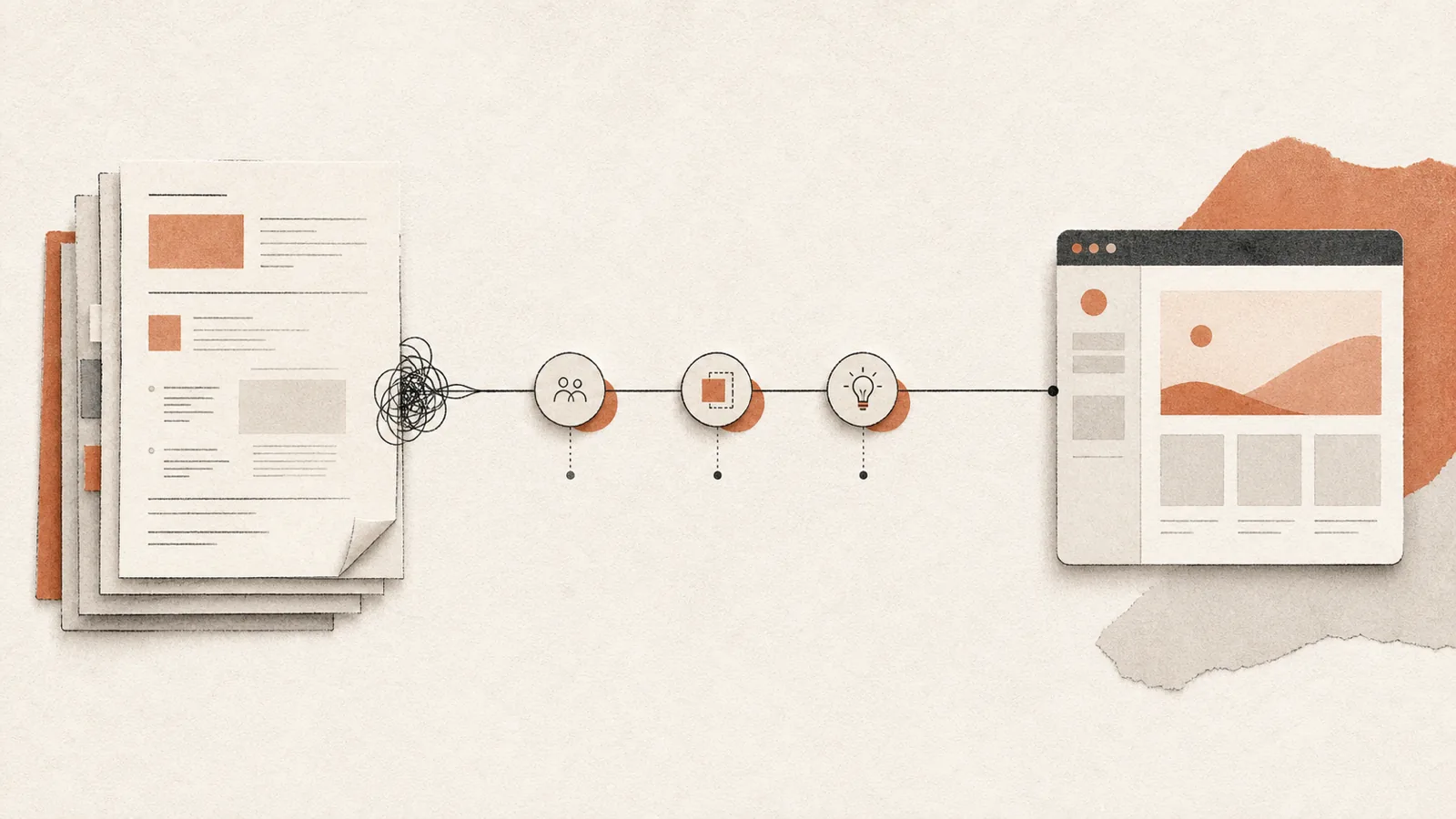
They are not four competing methods. They are one spectrum ordered by how much specification precedes the build, and the reason they only look like rivals is that the PRD was always doing three jobs at once:
- Alignment — get everyone holding the same idea (Frederick Brooks's design concept).
- Specification — define what to build precisely enough to build it.
- Rationale — record why the decisions were made, for future readers.
When agentic coding makes generation nearly free, each job is disrupted differently:
- Specification is dissolved. A prototype specifies more precisely than prose ("documents are imprecise; prototypes are concrete" — Prototype Over PRD), and building is cheap enough to specify-by-building (Building Is Cheap, Arguing Is Expensive). This is the job the spectrum is really about.
- Alignment is relocated, not removed. It moves earlier (grill before any artifact — Design Concept Grilling) or into the artifact (compare three real PRs / three prototypes). Matt Pocock's non-negotiable is that this is the one job you cannot skip.
- Rationale is orphaned. No position on the spectrum has a good home for "why we chose variation B." This is the genuinely unsolved part — flagged as an open question on both Building Is Cheap, Arguing Is Expensive and Prototype Over PRD.
So the spectrum is: how aggressively does each position dissolve the specification job, given that it has a credible way to handle alignment?
The spectrum#
Ordered from most pre-build specification to least:
| Position | Source | Pre-build spec | Where alignment happens | Durable artifact |
|---|---|---|---|---|
| Grill-then-PRD | Design Concept Grilling (Matt Pocock) | Maximal — relentless interview → destination PRD | In the grilling conversation, before any artifact exists | PRD + Kanban; PRD deleted after implementation |
| Lighter PRD | AI Native Product Cadence (Cat Wu) | Calibrated to ambiguity — 1-pager ↔ full PRD | Team principles + weekly metrics readouts push shared context | A 1-pager, or nothing |
| Build-to-decide | Building Is Cheap, Arguing Is Expensive (Fiona Fung) | Minimal upfront — generate three real PRs | In comparing the built artifacts (and their impact on callees) | The chosen PR; discussion lives in PRs |
| Prototype-is-spec | Prototype Over PRD (Dan Carey) | None — skip the PRD entirely | In the recorded why-not-what conversation and the prototype itself | The prototype |
Read left to right, the durable artifact migrates from prose about the thing to the thing itself, and the moment of alignment migrates from before building to through building. Cat Wu's "lighter PRD" and Carey's "no PRD" are the same practice at different settings — the AI Native Product Cadence page makes this explicit: "Where Cat Wu makes PRDs lighter, Carey removes them entirely — the cadence taken to its limit."
The reconciliation: relocation, not abolition#
The apparent contradiction — Pocock insists on reaching a design concept before building; Fung and Carey build to reach the decision — dissolves once you separate the three jobs. The wiki already holds the reconciliation in three places, and they agree:
- Building Is Cheap, Arguing Is Expensive: "cheap building doesn't abolish design thinking — it relocates it" into the built artifact.
- Prototype Over PRD: Carey "folds that alignment into the recorded why-conversation, and the prototype is its first expression."
- Design Concept Grilling: reconciled as "the prototype is the medium of the design concept, not a replacement for reaching one."
So nobody actually disagrees about alignment (job #1) — they disagree about which artifact carries it. Pocock carries it in a conversation that precedes the build; Fung and Carey carry it in the build. What changed is not whether you need a shared idea, but that the specification job (#2) got cheap enough to fold into the alignment step instead of being a separate downstream document.
The load-bearing move that makes the right end of the spectrum work is "why, not what" / "design the ideal interface for this problem" — the human specifies the problem and lets model capability fill the what. This is the same under-specify-and-let-capability-fill principle that Prototype Over PRD, Disposable Micro-Apps, and the bitter lesson all run on.
A second axis: lighter spec vs. richer artifact#
The spectrum above moves in one direction — less prose. But there is an orthogonal response to the same pressure: make the human-facing artifact richer rather than lighter. HTML as the New Markdown and Disposable Micro-Apps (Thariq Shihipar) keep a substantial plan but render it as interactive HTML (and spin up throwaway micro-apps to edit it), because as models improve the bottleneck becomes human attention, not model comprehension.
This is why the cluster is a plane, not a line:
- Model-facing spec shrinks as capability grows (Harness Shrinkage as Models Improve) — the axis Carey rides to "no PRD."
- Human-facing harness can grow to keep the human aligned — the axis Thariq rides to "richer HTML plan."
AI Native Product Cadence frames these as "opposite bets on PRDs at speed: Cat makes them lighter, Thariq makes them richer — both aimed at keeping humans aligned without slowing down." The PRD-replacement spectrum is the lighter axis; the HTML/micro-app move is the richer axis. Both are valid because they target different consumers of the spec.
Choosing a position: the preconditions#
Each position is safe only when its precondition holds. The spectrum is not a maturity ladder where "further right is more advanced" — it's a fit decision.
| Precondition | Pushes you toward |
|---|---|
| High stakes / fuzzy brief / costly to go wrong | Grill first (Design Concept Grilling: "bigger feature, fuzzier brief, higher cost → grill harder") |
| Short, well-scoped change ("rename this across the codebase") | Skip grilling; build directly — overhead is wasted |
| Prototype surface == product surface (visual/UI work) | Prototype-is-spec (Prototype Over PRD: Carey's domain is a design tool where the prototype is the product) |
| Backend / infra / data work | Heavier spec — the prototype may not capture the spec (AI Native Product Cadence: "full PRD for heavy-infra features") |
| Decision turns on impact to other code | Build-to-decide — three real PRs reveal callee impact a doc can't (Building Is Cheap, Arguing Is Expensive) |
| Verifiable success criteria exist | Anywhere right of grilling — build-to-decide assumes you can verify which build is better (Verification as the New Bottleneck) |
The deep precondition behind the whole right half is Verification as the New Bottleneck: "generate three and compare" is only an advance if comparison is cheaper than argument. When generation got cheap, the heavy upfront planning that existed to protect scarce engineering bandwidth lost its justification — which is why the spectrum opened up at all.
The two unsolved problems#
Pushing right on the spectrum buys speed but leaves two debts that the source pages flag and none fully answers:
-
The orphaned rationale (job #3). If design lives in PRs and prototypes and the PRD is deleted after implementation, where does "why we chose B over A" live for the next reader? Both Building Is Cheap, Arguing Is Expensive and Prototype Over PRD raise this as an open question, and it shares the staleness problem of Code as Source of Truth. The richer-artifact axis (HTML as the New Markdown) partially answers it — a durable interactive artifact can carry rationale a deleted PRD cannot — which is another reason the two axes are complementary, not rival.
-
The prototype-as-evidence trap. A fast prototype-as-spec proves the build was tractable, not that the problem is real. Problem-Solution Fit Discipline names this directly: "the prototype only validates that the building task was solvable, not that the problem is real or that the solution fits." The right end of the spectrum is most exposed to it, because the prototype's speed produces a feeling of progress that substitutes for validation. The discipline that closes the gap is unchanged by AI: the prototype is "a pressure-testing prop for conversations with potential users… these conversations are the real evidence." Relatedly, Build for the Next Model warns that "it almost works" is a capability bet, not evidence the problem is worth solving.
Bottom line#
There is no single right amount of PRD. The spectrum is a dial set per task by three readings: how fuzzy the brief is (fuzzier → grill harder, left), whether the prototype surface is the product surface (yes → prototype-is-spec, right), and whether you can verify which built option is better (yes → build-to-decide). Move right to dissolve the specification job; you must still pay for alignment somewhere (a why-conversation, a grill, a comparison) and you still owe rationale and real-user validation, which the dial does not provide for free. Cheap building relocated design thinking into the artifact; it did not abolish the thinking.
Addendum (2026-09-02): a position past the right pole, and a report of the left failing#
Spec-Driven Development as the New Waterfall adds a fifth position, from the craft tradition rather than product: Robert C. Martin (2026-08-19, practitioner-opinion) keeps no persisted spec at all — "the specifications are ephemeral, they go away… I look at the end result and say, well, that is the specification." It extends the table's rightward migration one step further than Carey: the durable artifact is not even the prototype but the checkers (CRAP score, mutation tests, dependency rules) that state what the system must be. Two things distinguish it from the four positions above. It comes with the axis's first first-hand report of the left end failing under agents — plan-first work is "always a disaster", because agents follow a defective plan past the point a human implementer would have stopped — and it names the economic premise the whole rightward move rests on: the cost of change near zero, which Martin himself flags as a prediction he expects to lose. Meanwhile The Committed-Artifact Chain (Anthropic Applied AI, vendor-claim, 2026-08-21) moves the other way, decomposing the PRD into three committed artifacts rather than deleting it — so the spectrum now has an occupied position beyond each pole, and neither new position brings a measurement with it.
Connections#
- Design Concept Grilling — the left pole: maximal pre-build alignment, PRD as deleted destination doc
- AI Native Product Cadence — the calibrated middle: PRDs only when needed; frames the lighter-vs-richer axis split
- Building Is Cheap, Arguing Is Expensive — build-to-decide: comparison of built artifacts replaces abstract argument
- Prototype Over PRD — the right pole: the prototype is the spec
- HTML as the New Markdown / Disposable Micro-Apps — the orthogonal richer-artifact axis (human-facing harness grows)
- Verification as the New Bottleneck — the upstream cause that opened the spectrum, and the precondition for its right half
- Problem-Solution Fit Discipline — the prototype-as-evidence trap the right end is most exposed to
- Build for the Next Model — "it almost works" is a capability bet, not problem-validation
- Harness Shrinkage as Models Improve — the model-facing-spec-shrinks principle that drives the move rightward
- Code as Source of Truth — where the orphaned-rationale problem inherits its staleness risk
- Spec-Driven Development as the New Waterfall — past the right pole: no persisted spec, checkers as the durable artifact, and the first report of plan-first failing under agents
- The Committed-Artifact Chain — the counter-move: PRD decomposed into three committed artifacts rather than deleted
Sources#
- Design Concept Grilling — Matt Pocock, grill-me / PRD-as-destination
- AI Native Product Cadence — Cat Wu, lighter PRDs (+ Dan Carey corroboration)
- Building Is Cheap, Arguing Is Expensive — Fiona Fung, generate-three-PRs
- Prototype Over PRD — Dan Carey, prototype-is-spec
- HTML as the New Markdown / Disposable Micro-Apps — Thariq Shihipar, richer-artifact axis
- Problem-Solution Fit Discipline — the founder's-playbook validation discipline
- Verification as the New Bottleneck — the bottleneck shift that opened the spectrum
- Build for the Next Model — capability-bet caution
Cited by 11
- Where Does the Why Live?×4
In this wiki, the why is rationale — the record of why a decision was made. It is one of the three…
- Is Persistence the Line Between Prompting and Spec-Driven Development?×3
The grilling transcript. Design Concept Grilling is the left pole of the PRD-replacement spectrum —…
- Playbook Boundary Conditions: the Devil's-Advocate Substrate and the Prototype's Edge×2
Q1: Problem Solution Fit Discipline, Claude Character As Product, Harness Shrinkage As Models…
- Rationale as a Dated Record: Where the Why Lives for the Next Reader×2
Prototype Over Prd's residual was whether any durable read-time home exists that doesn't bring the…
- Spec-Driven Development as the New Waterfall×2
Prd Replacement Spectrum At Ai Native Speed — the corpus's spec-weight axis; this page sits past…
- AI Native Product Cadence
Prd Replacement Spectrum At Ai Native Speed — lighter-PRD is the calibrated middle of the spectrum;…
- Building Is Cheap, Arguing Is Expensive
Prd Replacement Spectrum At Ai Native Speed — build-to-decide as a midpoint of the spectrum; the…
- The Committed-Artifact Chain
Prd Replacement Spectrum At Ai Native Speed — where this sits on the spectrum: not PRD-deletion but…
- Design Concept Grilling
Prd Replacement Spectrum At Ai Native Speed — the left pole of the spectrum: maximal pre-build…
- Product & Organization
Prd Replacement Spectrum At Ai Native Speed — Four positions (grill-then-PRD → lighter-PRD →…
- Prototype Over PRD
Prd Replacement Spectrum At Ai Native Speed — the right pole of the spectrum: the prototype is the…
Related articles
- Prototype Over PRD
Dan Carey's prototype-replaces-PRD method: record a why-not-what conversation, transcribe it, hand the transcript to Cl…
- Evals as Product Spec
Cat Wu's framing of evals as the emerging core PM skill: ten great evals beats a hundred mediocre; encode what done loo…
- Building Is Cheap, Arguing Is Expensive
"In technical debate, code wins": generate three PRs vs whiteboard; prototype over design doc; reduce design docs
- Open Questions Backlog
Generated by `_system/lint.py --write-backlog`. Do not hand-edit. Domain and Watching sections carry one row per page —…
- Is Persistence the Line Between Prompting and Spec-Driven Development?
No — persistence is an observable proxy for the property that actually matters, which is authority: whether later work…