Sources#
- Anthropic's Boris Cherny: Why Coding Is Solved, and What Comes Next
- Designing with Claude: From prompt to production
- How Anthropic's product team moves faster than anyone else | Cat Wu (Head of Product, Claude Code)
- How software engineering is changing: a tale of two eras
- How we rebuilt the Shopify app in 12 weeks
- Inside AI-pilled engineering teams: Five lessons for scaling without losing the plot
- The state of the tech industry in 2026
Summary#
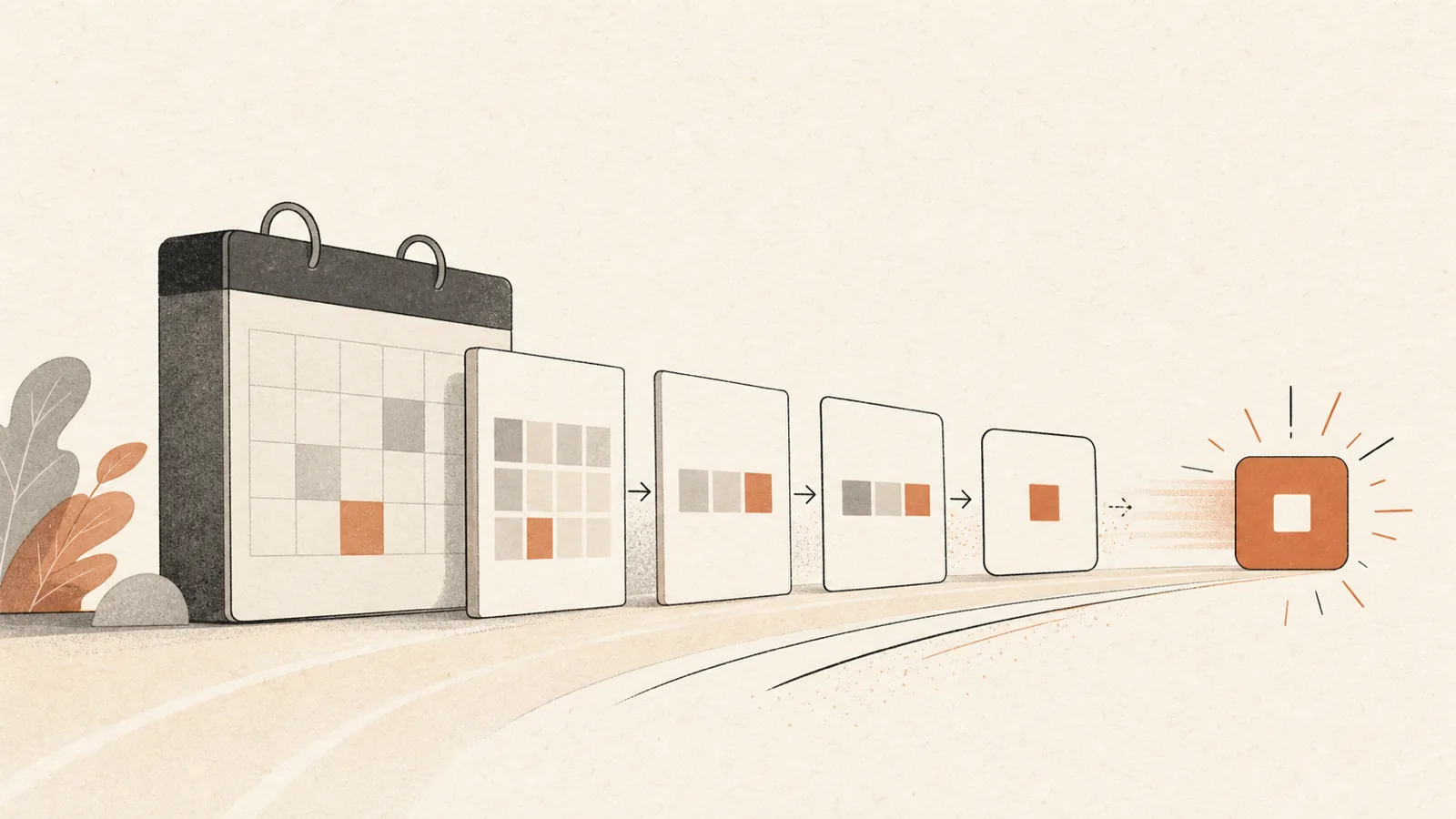
Cat Wu's account of how Anthropic ships at a pace that surprises observers. Cycle time per product feature went from 6 months → 1 month → sometimes 1 day. The mechanisms are mostly removed process, not added: research-preview branding to lower commitment, mission-as-tiebreaker to remove cross-team negotiation, evergreen launch room with same-day docs/marketing turnaround, no PRDs for ambiguous features, and engineer-with-product-taste as the unit of delivery (see Engineer PM Convergence).
What "fast" actually looks like#
- A team-member's idea on Monday → research preview live by end of week.
- Source: Lenny: "Someone made a calendar of launches across Anthropic, and it was literally every day a major feature or product."
- "Sometimes" 1-day timelines for individual features, not the bulk — but the bulk is one-month, where industry norm is one-quarter.
What does not explain it#
Cat is asked directly whether internal access to Mythos explains the velocity:
"It's not fully Mythos. We do use the models internally, and I think this has increased our rate of shipping a little bit, but I don't think it explains the bulk of the increase. I think a lot of it is the process and the expectation on the team."
Take seriously: the model isn't the bottleneck; process is.
Six practices that compose the cadence#
1. Research-preview branding#
Most launches ship as "research preview" with explicit branding. This:
- Sets user expectation that the feature is early and may change
- Lowers internal commitment — team isn't locked into supporting it forever
- Allows ship-without-completeness — get the idea in front of users in a week, iterate based on feedback
2. Mission as tiebreaker#
"If there's two competing priorities, we'll talk about which one is more important for Anthropic's mission."
Removes the most expensive coordination cost: priority debates between teams. The mission ("safe AGI for humanity") sits above any individual product. When teams conflict, the mission decides — and "everyone will stand behind the one we decide."
This is process-removal via shared values rather than process-addition via meetings.
3. Evergreen launch room#
"Engineers post [a finished feature] in our evergreen launch room. Sarah who leads our docs and Alex who leads PMM and Tar and Lydia on Devril just jump in and can turn around the marketing announcement the very next day."
A standing channel where finished features get docs + marketing same-day. This eliminates the sequential handoff (engineering → PM → marketing → docs → ship) that costs most teams weeks.
4. PRDs only when needed#
- Ambiguous features → 1-pager: goals, delightful use cases, current failure modes
- Heavy-infra features → full PRD
- Most features → no PRD; metrics readouts + team principles do the alignment work
Cat's team principles list "who our key users are, why those are our key users… so that everybody on the team feels like they understand how our business works and what we're willing to trade off."
5. Metrics readouts every week#
The whole team reviews business metrics weekly. This pushes context out so individual decisions don't need PM approval — anyone on the team has the same view of what's working.
6. Engineer with product taste as delivery unit#
"Many engineers on our team are fully able to end-to-end go from see user feedback on Twitter through to ship a product at the end of the week with almost no product involvement."
When the engineer has taste, the handoffs disappear. The PM role becomes a force-multiplier (cross-functional unblocking, team principles, harder strategic calls) rather than a sequential gate.
See Engineer PM Convergence for the cross-disciplinary version.
What gets sacrificed#
Cat names the explicit trade-off:
"We're sacrificing product consistency. Historically, when code was expensive to write, you would carefully plan everything in your product suite, how every product relates to each other. Now with AI moving so quickly, we do sometimes have features that overlap with each other."
Symptoms:
- New users don't know which feature solves their problem (multiple do, slightly differently)
- Users feel "they're on this ever increasingly fast treadmill"
- Need for built-in onboarding (
/powerupcommand in Claude Code launched late, against the original "the product should be intuitive" principle, because feature count outran intuition)
Cat's characterization: "the cost of launching a lot of features." A real cost, not a non-issue.
What gets harder#
- Code review. When agents ship more code, humans review more. Matt Pocock's confession applies: "I don't honestly know what the answer is yet."
- Quality bar. Some shipped features are buggier than Cat would like. Acceptable because "as long as it's not blocking the core use case, it's okay because we'll hear the feedback and we'll fix in the next release."
- Career ladders / role clarity. Implicit casualty of Engineer PM Convergence.
Cultural substrate: face challenges with a smile#
"Our team is full of people who lean into the chaos. We try to face every challenge with a smile because there's always so much going on. There's always so many risks and tricky situations that if you get too stressed about anything you'll burn out."
Hire industry veterans who know how to maintain energy across long ramps; bias for low-ego people who treat the chaos as exciting rather than overwhelming. Lenny's observation: every Anthropic employee he's met is "chill and optimistic."
"Just do things"#
Cat's life motto. Captures the substrate that makes the cadence possible: people don't wait for permission, jobs aren't "fake" but role boundaries are flexible, action is the default. When this collides with mission alignment, you get Anthropic's velocity. Without mission alignment, "just do things" produces drift.
Independent corroboration: Anthropic Labs#
Dan Carey's May 2026 account of building Claude Design inside Anthropic Labs independently reproduces nearly every practice on this page — a different team, a year later. Labs ran the same loop "between 50 and 100 times" in ten weeks; shipped most work as a research preview; wrote no PRD, no vision doc, no OKR meeting (see Prototype Over PRD); shipped daily ("we aim to ship to users every day or two"); and treated the build loop itself as the object to optimize (see Compounding Loop Optimization). Concrete velocity proof: 62 improvements shipped between a Friday launch and the following Monday. Where Cat Wu makes PRDs lighter, Carey removes them entirely — the cadence taken to its limit.
The structural version: decouple shipping from releasing#
Ramp (Geoff Charles, CPO; case-study, June 2026) solves the same speed-vs-quality problem this page's six practices solve culturally, and does it with one structural change instead. The stated starting condition is the one every practice above is downstream of: the team "ships major new features every day," which "makes it nearly impossible for leadership to stay fully up to speed."
Two tiers, and the gate moves off the ship decision. Teams ship to an early-access tier whenever they're ready — no approval. Roughly 10% of Ramp customers opt in, giving a standing test group of 5,000+ businesses. Only the promotion from early access to general availability is gated, and it is gated on evidence via a templated seven-item checklist: what was built and why; a ≤3-minute Loom demo; KPIs observed during early access; customer feedback; first-time-user journey; sales and support readiness; and a rollout plan with launch tier, pricing, and comms. Much of the assembly is automated by AI wired into Ramp's systems, and the review carries a 48-hour default-to-ship SLA — leaders review within two days or the feature goes.
Three things make this a different answer from the ones above rather than a restatement:
- It is the same insight as research-preview branding (#1), converted from a naming convention into a customer segment. A research preview lowers the expectation attached to a launch; the early-access tier lowers the exposure. The first is a promise to users, the second is a population — and only the second produces the KPI evidence the promotion gate then consumes.
- The evidence loop closes. The checklist demands "KPIs during early access," which is only answerable because the early tier exists. This is the concrete form of the loop-completion metric Nathan proposes below: a feature that ships to early access and never gathers evidence simply never promotes, so incomplete loops are visible by construction rather than by discipline.
- The default is inverted. A 48-hour review that expires in favor of shipping puts the cost of a slow gate on the gatekeeper. Compare Prototype Over PRD and practice #4 — same instinct (remove the artifact that makes leadership the bottleneck), applied to approval rather than to specification.
What the source does not supply: any measurement that the two-tier gate preserved quality. The 5,000-business test group and 48-hour SLA are described; no defect, reversion, or escalation data accompanies them, and Ramp is a portfolio company of the publisher.
The measurement problem cadence creates: motion vs. progress#
Everything above optimizes throughput. Akshay Nathan (OpenAI, productivity engineering) names the failure mode that optimization invites, and it is the sharpest counterpoint on this page (Codex from 0 to 10M Users: Building ChatGPT Work - Akshay Nathan, OpenAI, practitioner-opinion):
"Maybe the trap is conflating motion and progress. I think motion is much easier now than ever before because of the tooling that we have. But progress requires you to be very prescriptive and deliberate about what you're trying to achieve."
Asked directly whether teams that "added a lot of LLMs and have dashboards for this and that, but not much has changed" are falling into a trap, his answer is one word: "That is the trap, yes."
The proxies broke. Nathan's account of why: what teams always wanted to measure was "were you able to hit the goal," and they used proxies — commits, lines of code, story points — because the goal wasn't directly measurable. Under agents the proxies decouple: "the number of tokens you use or the number of pull requests you make are no longer as hypercorrelated with, is your team able to hit the goal." This applies to practice #5 above (weekly metrics readouts): a cadence measured in shipped features is measuring motion unless someone has separately said what progress means. Compare Telemetry vs. Survey Measurement on the general instrument problem, and note OpenAI has the same gap on the user side — Nathan says outright that measuring whether the product made users productive is unsolved ("we haven't figured this out yet… everyone has different goals"), and that thumbs-up/down is uninterpretable because you can't tell whether the user is rating the content, the vibe, or the outcome.
His replacement is quality of at-bats, not count of them. "Are we as a team building the muscle to have not just quantity of at-bats, but quality? Are we able to go all the way from generating an idea, building it out, getting the feedback, reacting to that feedback, validating or invalidating the hypothesis, going on to the next idea?" That is a loop-completion metric rather than an output metric — it counts full idea→build→feedback→verdict cycles, so a fast team that never closes the loop scores zero. He includes team culture in it explicitly ("the humility… to go through that process many times and stay motivated"), which makes it unmeasurable as stated; treat it as a framing, not an instrument.
How the cadence scales: replicate the small unit (Orosz, October 2026)#
Every account above is one team. Gergely Orosz's LDX3 keynote write-up (The Pragmatic Engineer, 2026-10-06, practitioner-opinion) surveys AI labs, startups and Big Tech. It answers part of the scaling question with two quotes from inside Anthropic and a pattern seen across the companies he visited.
At Anthropic the unit did not grow. Katelyn Lesse, Head of Engineering for Claude Platform, pushes back on "two humans and a bunch of agents": "I still have teams whose job it is to own a piece of software, iterate on it, own oncall… the size and shape of the team is still similar. We still have two-pizza teams." On one project, though, "you often cannot have more than two people working on it," because each engineer's agents already conflict on implementation. So the cadence scales across a company of Anthropic's size by replicating small, ownership-bearing teams, with projects inside them narrowed to one or two engineers. It does not scale by making any one team bigger. Lesse also reports that complex work still gets "a typical pre-AI planning process." Claude Managed Agents had documents "dating back up to two years" before it was built. So the six-month-to-one-day compression applies to features, not to every project.
The structural substrate is spreading beyond the labs. Orosz reports dev work starting in Slack: "@Codex, implement this" at OpenAI, "@Claude build this" at Anthropic, "@Linear work on this" at Linear. He also lists in-house agent harnesses at Stripe, Uber, Block, Shopify, Google, Meta, Amazon, Dropbox, Spotify and others, plus "agentic software factories" wired into CI/CD and deploys. These are the request-to-ship pipes that the evergreen launch room (#3) assumes. Their spread is evidence that the structural half of the cadence can be copied. The post shows no shipping cadence for any of these companies.
The costs above, reported industry-wide. "Quality and reliability down" is one of Orosz's "what's broken" items, carried by Mario Zechner's "98% uptime becoming the norm" (he concedes the trend predates agents) and by no measurement. That is Cat Wu's "buggier than I'd like" trade-off, observed across many products. The builder-side treadmill shows up too. Dima Zaytsev (Linear) reports that "the expectation has become that everyone works on parallel things. And so, I end up feeling I have more work compared to pre-AI." Cat's users feel the treadmill from outside, and Zaytsev feels it from inside.
A cultural filter, made explicit. A Series D Director of Engineering told Orosz that "AI positivity was something we started to screen for in our hiring process." That bears on the structural-vs-cultural question below. At least some firms are buying the cultural half through hiring rather than growing it.
The small unit adopted on purpose (Shopify, November 2026)#
Lesse's two-engineer ceiling above is reported as a limit Anthropic runs into. Shopify adopted it as the design for a 30-engineer project (How we rebuilt the Shopify app in 12 weeks, Remi Vanhee, Shopify Engineering, 2026-11-10, case-study, first-party). It rebuilt its mobile app in 12 weeks with pods of two, each owning a product area on both iOS and Android, each engineer steering several agents, and agents running overnight so "every morning started with a queue of PRs to review." "We kept the pods small on purpose. Agents gave each pair the implementation capacity to cover a whole product area. What each pod needed was clear ownership, fast decisions, and shared context." The organizing unit is the product area, not the platform team. Shopify's reason for keeping it is coordination: once fixes outrun tickets, ownership by area is what stops two pods' agents from fixing the same bug (Bottleneck Succession After Cheap Code).
This is a migration with a fixed target and an end date, not a feature cadence, and it reports no cycle time. What it adds to the scaling question is a second company converging on the same unit size for the same reason, the collision of agents, and replicating it about fifteen times rather than enlarging it.
The unit at one person, with the review gate removed (Tano, November 2026)#
Neil Kakkar's essay (How software engineering is changing: a tale of two eras, The Pragmatic Engineer, 2026-11-03, case-study) shows the cadence at a 10-person AI-native startup, measured through one engineer's PRs: 207 merged per month against 19 at pre-AI PostHog. It extends the practices above in three directions.
- The unit shrinks from two to one. "A big part of moving fast is having just one person responsible for things." A survey feature built at PostHog by two engineers and a designer in a month would now be one person's, covering design, frontend and backend, because "now that writing code is faster, a communication overhead makes little sense." Tano has no PMs (engineers take the role, see Engineer PM Convergence). "What used to take a month now often takes a week." Lesse's ceiling and Shopify's pods were two people. Tano is one, and it pays with a bus factor of one.
- The quality trade-off is chosen in advance. Cat Wu accepts buggier features because "we'll fix in the next release." Tano makes the same trade at the review gate. Human review is optional, an agent usually reviews alone, and the team fixes forward. Two escapes are named: a currency-unit bug fixed within the hour, and a migration that paid creators twice. "How fast we want to move is a conscious decision now." Design is the other thing given up. The site is "AI-generated neo-brutalist," like many others, and Kakkar observes early-stage startups discounting design work generally.
- The cost lands on the builder. Zaytsev's "more work compared to pre-AI" reappears as running 3-5 workstreams at once, thrashing, and exhaustion by mid-afternoon, managed with personal guardrails (laptop left at the office, a 6 PM stop). See Bottleneck Succession After Cheap Code for where the constraint went.
Gergely Orosz, who published the essay, reads the contrast as a temporary advantage: "pre-AI" startups "will eventually catch up," but a business that works well has reason to change its process carefully. He adds that "iteration speed is pretty meaningless by itself" without product-market fit or unit economics. That is Nathan's motion-vs-progress warning above, from a journalist rather than an operator. Everything here is one engineer at one firm. The pre-AI and AI-native periods differ in employer, product stage and review policy as well as in tools.
Connections#
- Cat Wu — primary articulator
- Dan Carey — independent corroboration from Anthropic Labs (the Claude Design build)
- Prototype Over PRD — the no-PRD limit of the lighter-PRD practice on this page
- Compounding Loop Optimization — the per-loop optimization discipline that powers the cadence
- Anthropic Labs — the bet-factory that runs this cadence at the team level
- Boris Cherny — converging report ("we plan in 1 week out")
- Engineer PM Convergence — the role architecture that makes the cadence work
- Harness Shrinkage as Models Improve — internal harness pruning is itself an example of the cadence applied to internal tooling
- Claude Character as Product — character work moves at this same cadence; Amanda's iteration loop is a tight example
- Claude Code Best Practices — the public artifacts of a team operating at this cadence
- Human-AI Accountability Redesign — the cross-functional/workforce mirror of internal cadence redesign; HBR's prescription generalizes Anthropic's approach
- AI Employee Framing — pushback on "anthropomorphizing accelerates adoption"; per HBR, what actually accelerates is managerial role-modeling — consistent with Cat's "everyone codes" practice
- HTML as the New Markdown — opposite bet on PRDs at speed: Cat makes them lighter (1-pagers, metrics readouts), Thariq Shihipar makes them richer (interactive HTML) — both aimed at keeping humans aligned without slowing down
- Seven Powers Applied to AI — building AI-native is an operational advantage (this cadence), not only a strategic one; the moats analysis explains why incumbents can't easily copy it
- Zero-Friction Scope Creep — Anthropic's internal shipping cadence is the with-strong-judgment version; first-time founders without that judgment substrate face scope-creep risk that the cadence alone doesn't solve
- Evals as Product Spec — the regression guardrail that makes the 6mo→1day cadence sustainable; weekly/monthly releases would be too risky without ten-great-evals-per-feature as a safety net
- Telemetry vs. Survey Measurement — the instrument problem behind "motion vs. progress": the readouts that are easy to collect are the ones that decoupled from the outcome
- Bottleneck Succession After Cheap Code — what the small unit is protecting against at scale: once code is cheap, review, merging and coordination become the constraints, and Shopify sized its pods to the coordination one
- Organizational Complements to AI — AI-native orgs are born with the workflow/review/tooling complements this cadence depends on, rather than retrofitting them; the low cost of process experimentation is why agentic-AI complements may diffuse faster than electrification's
Open Questions#
- Does the cadence scale beyond ~100 people? Anthropic itself is bigger (~30-40 PMs alone), but the Claude Code team that visibly drives cadence is small. Partially answered (2026-10-14) by The state of the tech industry in 2026 (
practitioner-opinion). At Anthropic's own size the answer is to replicate the unit rather than enlarge it. Katelyn Lesse (Claude Platform) says teams are "still two-pizza teams" that own software and on-call. Individual projects are capped at one or two engineers, because more humans bring more agents that collide. Complex projects still run a pre-AI planning process. Orosz also finds the structural substrate (Slack-started work, in-house harnesses, agentic CI/CD) at Big Tech companies. Still open: no source measures feature cycle time at any organization larger than one team, so whether the 1-month norm survives at a few thousand people is unknown. - What's the equivalent of research-preview branding for B2B enterprise launches where customers expect stability? Cat doesn't address. Partially answered (2026-10-21): Inside AI-pilled engineering teams: Five lessons for scaling without losing the plot (
case-study) gives a B2B analogue in Ramp's two-tier release: any team ships to an opt-in early-access tier (about 10% of customers, 5,000+ businesses), and general availability needs a templated evidence checklist (demo, KPIs, customer feedback, first-user journey). Stability expectations are met by gating GA rather than by branding. It is one fintech with a self-selected tier and reports no enterprise-customer reaction; GA-conversion and complaint data from such tiers would settle it. - How much of the cadence is structural (process choices) vs cultural (talent density)? Probably both, ratio unclear. Partially answered (2026-10-14) by The state of the tech industry in 2026 (
practitioner-opinion). Both halves are now visible outside Anthropic, but there is still no ratio. The structural half is being copied: Slack-started work, in-house harnesses and agentic software factories at many named companies. The cultural half is being bought through hiring, with a Series D startup screening candidates for "AI positivity." No source compares a company that copied the structure without the culture against one that did the reverse. Partially answered (2026-11-23): How software engineering is changing: a tale of two eras (case-study, one engineer, argument not measurement). Kakkar calls culture "a necessary – and sufficient – condition," but his own thought experiment makes a process rule the binding cap. An engineer with 2026 agents at pre-AI PostHog, where review is mandatory, would get "at best… a 1-2x productivity gain," because peers' review capacity sets the pace. On that argument the structural half (who must approve) bounds the gain before culture matters. It is still unmeasured, and the bullet's settler stands. Checked for split: neither partial settles a separable sub-claim.
Derived#
- Learning to Co-Work with AI: A Software Engineer's Field Guide — taste-calibration loop and lunchtime vibe-checks adopted as individual practices
- AI-Native Product Org Bottlenecks — frames cadence as the stress test for accountable taste: dogfooding trains it, evals encode it, accountability owns it
- The PRD-Replacement Spectrum at AI-Native Speed — lighter-PRD is the calibrated middle of the spectrum; the lighter-vs-richer-artifact axis split is drawn here
Sources#
- How Anthropic's product team moves faster than anyone else | Cat Wu (Head of Product, Claude Code)
- Anthropic's Boris Cherny: Why Coding Is Solved, and What Comes Next
- Codex from 0 to 10M Users: Building ChatGPT Work - Akshay Nathan, OpenAI — Latent Space, 2026-07-28 (
practitioner-opinion): Akshay Nathan on motion-vs-progress as the trap, the collapse of commit/LOC/PR/token proxies, and quality-of-at-bats as the replacement framing - Inside AI-pilled engineering teams: Five lessons for scaling without losing the plot — Bessemer Atlas, 2026-06-10 (
case-study): §1, Ramp's two-tier release gate — early access at ~10% of customers (5,000+ businesses), a seven-item evidence checklist for GA promotion, 48-hour default-to-ship review. Geoff Charles is CPO at a Bessemer portfolio company; no quality data accompanies the process description - The state of the tech industry in 2026 — Gergely Orosz, The Pragmatic Engineer, 2026-10-06,
practitioner-opinion(LDX3 keynote write-up, free portion). Cited for Katelyn Lesse's two-pizza-team and two-engineers-per-project quotes and the Managed Agents planning quote (§2 #12, §4), Slack-started work and the in-house harness list (§2 #7–#8), the quality-down and personal-focus items (§3), and the AI-positivity hiring screen (§5). Relayed interviews, no cadence measurement - How we rebuilt the Shopify app in 12 weeks — Remi Vanhee, Shopify Engineering, 2026-11-10,
case-study, first-party. Cited for pods of two owning product areas across both platforms, the overnight agent PR queue, and the stated reason for keeping pods small. No cycle-time figure - How software engineering is changing: a tale of two eras — Neil Kakkar, How software engineering is changing: a tale of two eras, The Pragmatic Engineer, 2026-11-03, essay-challenge winner with Gergely Orosz's intro and takeaways,
case-study: one engineer's PR history at Bloomberg, pre-AI PostHog and Tano. Cited for one-person ownership, no PMs, month-to-week, the optional-review and fix-forward trade-off, design discounting, the builder-side load, the time-traveller argument and Orosz's temporary-advantage and PMF caveats
Cited by 35
- The PRD-Replacement Spectrum at AI-Native Speed×7
Ai Native Product Cadence frames these as "opposite bets on PRDs at speed: Cat makes them lighter,…
- AI-Native Product Org Bottlenecks×6
Ai Native Product Cadence says the model is not the main bottleneck: Cat Wu attributes the 6-month…
- Prototype Over PRD×5
"All we knew is that we had a spark." Removing these is what Compounding Loop Optimization frees up…
- Learning to Co-Work with AI: A Software Engineer's Field Guide×4
Ship things, get feedback, iterate fast. Ai Native Product Cadence reports Anthropic's Claude Code…
- Opinions on Using AI Tools & the Future of the Software Engineering Role×3
Code-review fluency — the new bottleneck once agents ship faster (Matt Pocock, Ai Native Product…
- Open Questions Backlog×3
Ai Native Product Cadence: What's the equivalent of research-preview branding for B2B enterprise…
- AI Employee Framing×2
This connects to engineer-PM convergence and Ai Native Product Cadence: visible managerial AI use…
- Anthropic×2
AI safety company; vendor of the Claude model family. Run by two siblings: Dario Amodei is CEO, and…
- Bottleneck Succession After Cheap Code×2
Coordination. Katelyn Lesse (Anthropic, via Orosz) caps a project at one or two engineers because…
- Build for the Next Model×2
The same logic reshapes roadmaps. Ambrosino: "the shorter-term something is, the more detail it…
- Excellence as an Operating System×2
Ai Native Product Cadence — Anthropic's cadence culture shares the mission-as-tiebreaker and…
- Human-AI Accountability Redesign×2
Ai Native Product Cadence — Cat Wu's account of how Anthropic redesigned product cadence is one…
- Managers as ICs×2
This is the management-layer instance of Engineer Pm Convergence: Boris Cherny notes every member…
- Playbook Boundary Conditions: the Devil's-Advocate Substrate and the Prototype's Edge×2
Cross-cutting invariants — data integrity, security, scale, migration safety, cost ceilings. These…
- Polish No Longer Signals Readiness×2
Mechanisms the corpus already holds that re-supply the missing signal: "research preview" branding…
- Anthropic Labs
Ai Native Product Cadence — the bet-factory cadence is the same ship-fast/research-preview pattern…
- Building Is Cheap, Arguing Is Expensive
Ai Native Product Cadence — prototyping-over-docs is part of the lighter-PRD cadence
- Cat Wu
Head of Product for Claude Code and Cowork at Anthropic; primary articulator of AI-native product cadence and engineer-…
- Claude Character as Product
Ai Native Product Cadence — character launches happen at the same cadence as features
- Claude Code
Ai Native Product Cadence — Cat Wu's articulation of how the team ships
- Claude Code Best Practices
Ai Native Product Cadence — these best-practice artifacts are the public output of a team operating…
- Claude Managed Agents
The product predates this source. Katelyn Lesse, Head of Engineering for Claude Platform, said its…
- Compounding Loop Optimization
Ai Native Product Cadence — the team-and-process cadence this loop runs inside; Carey is a second…
- Engineer PM Convergence
Ai Native Product Cadence — the cadence that makes role merging viable
- Evals as Product Spec
Ai Native Product Cadence — the rapid cadence is sustainable only because evals provide regression…
- HTML as the New Markdown
Ai Native Product Cadence — Cat Wu makes PRDs lighter; Thariq makes them richer — different bets on…
- Product & Organization
Ai Native Product Cadence (hub) — Cat Wu's 6mo→1mo→1day cadence at Anthropic: research-preview…
- Mythos Model
Ai Native Product Cadence — explicitly disclaimed as the cadence explanation, but contributes
- Organizational Complements to AI
Ai Native Product Cadence — the startup-side version: AI-native orgs are born with the complements…
- Product Velocity as Moat
Ai Native Product Cadence — Anthropic's 6mo→1mo→1day cadence is the same velocity-as-advantage…
- Seven Powers Applied to AI
Ai Native Product Cadence — startup advantage of building AI-native is operational, not just…
- Telemetry vs. Survey Measurement
Ai Native Product Cadence — the limit of the telemetry side: OpenAI's Akshay Nathan reports the…
- Thariq Shihipar
Ai Native Product Cadence — his richer-HTML-PRD bet is the counterpoint to Cat Wu's lighter-PRD bet
- The Three Loops of AI-Native Building
Ai Native Product Cadence — the org-level cadence the outer loops set; the external loop is the…
- Zero-Friction Scope Creep
How does this interact with Cat Wu's 1-day shipping cadence? Anthropic's internal practice ships…
Related articles
- Engineer PM Convergence
Generalists across disciplines; product taste as bottleneck skill; Anthropic Claude Code team as case study; "just do t…
- Harness Shrinkage as Models Improve
Prompt scaffolding shrinks each model release; Cat Wu's pruning discipline; Boris Cherny "100 lines of code a year from…
- Claude Code
Anthropic's agentic coding product; created by Boris Cherny late 2024; TypeScript/React on Bun (itself Claude-rewritten…
- Cat Wu
Head of Product for Claude Code and Cowork at Anthropic; primary articulator of AI-native product cadence and engineer-…
- Anthropic
AI safety company / vendor of Claude; mission-as-tiebreaker culture; ~30–40 PMs across teams; Mike Krieger leads Labs r…