Sources#
- …and the proof is checked in Lean
- After Math
- AI Has Solved One of Math's $1 Million Millennium Prize Problems
- Did OpenAI solve the wrong Navier-Stokes problem?
- FLT: Anthropic has beaten me to it
- How to Formalize All of Mathematics
- Navier-Stokes lost in translation: Why Lean verification of AI autoformalisation does not guarantee correct natural language proofs
- On the Navier–Stokes Millennium Prize Problem
- The Buckmaster Interview (Navier-Stokes) - Numberphile
- Unforced Euler singularity, unforced Navier-Stokes singularity, and the Generalized Riemann Hypothesis
- What mathematicians should know about the Lean Theorem Prover: questions of reliability and AI
Summary#
On 2026-09-08 OpenAI published On the Navier–Stokes Millennium Prize Problem (On the Navier–Stokes Millennium Prize Problem, no individual byline, ~1,900 words, vendor-claim), announcing that a system of its agents, powered by an unreleased internal model, had produced a proof that three-dimensional incompressible Navier–Stokes dynamics can develop a finite-time singularity, together with a Lean formalization. A companion result on the Euler equations is announced in the same post.
This page exists because the event was already load-bearing across a dozen wiki pages before the first-party account was compiled — the "10,000 agents, 130 billion tokens, 88 hours" triple entered the corpus through Brown's Dwarkesh interview nine days later and is cited on Multi-Agent Collective Intelligence, Compute-Controlled Benchmarking, Autonomous Scientific Discovery, Evaluation Horizon Versus Release Cadence and Latent Capability Overhang. The announcement is the primary document for those figures, it adds several the interview does not, and it contradicts one thing the corpus had recorded (that no formalization was claimed). Everything below is OpenAI's claim about its own unreleased system. The tier is vendor-claim and does not move: the result is disputed, and as of 2026-09-21 no independent verification of any kind is in this corpus.
What is actually claimed#
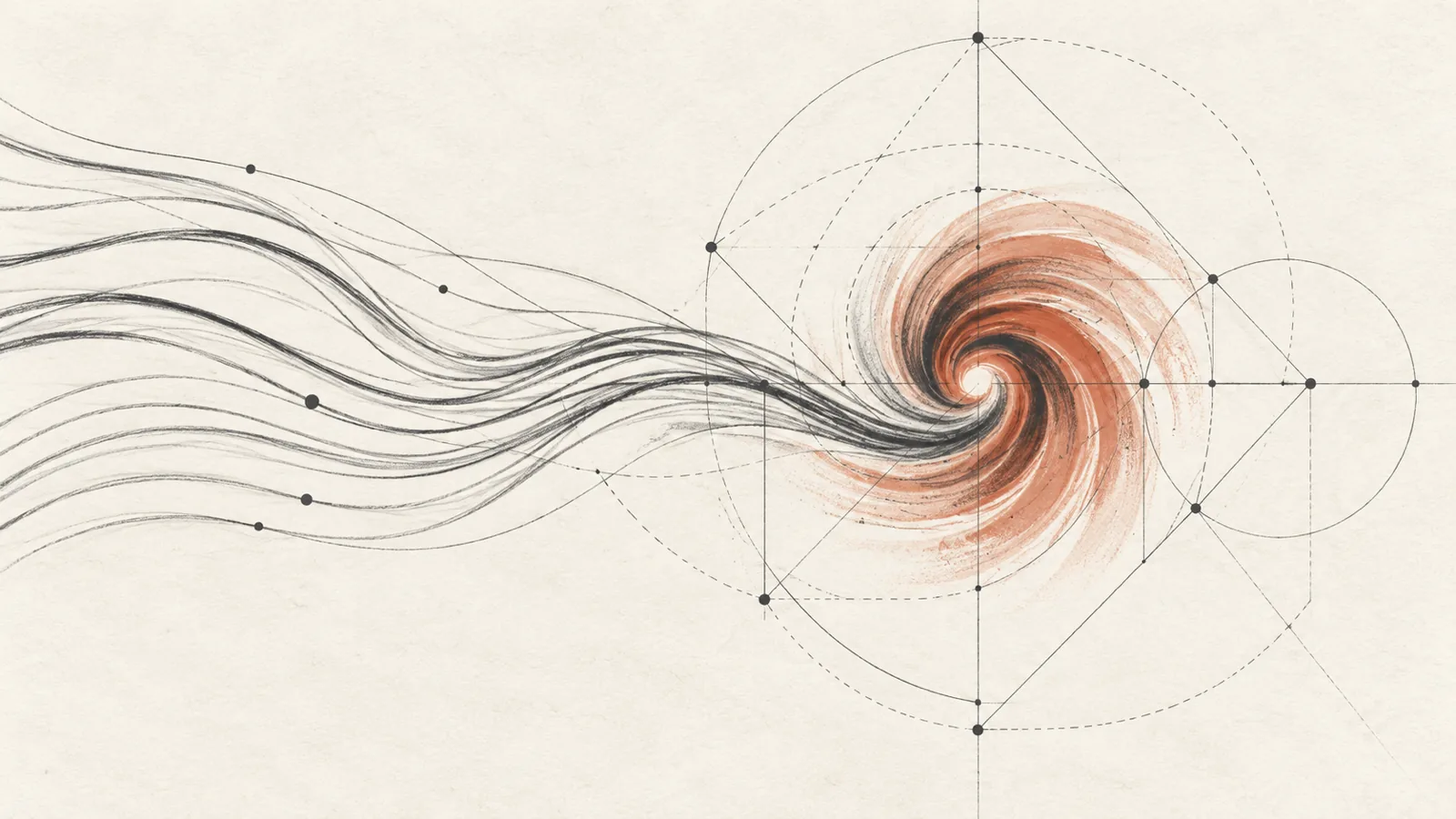
The mathematical statement. OpenAI claims its system produced "an analytical proof and a Lean formalization that an initially smooth fluid at rest can develop a singularity in a finite time," with a smooth force applied and energy finite throughout, from rest to blow-up. In the Clay Mathematics Institute's formulation this resolves the problem by establishing statement "C" (and also "D") — the breakdown branch, not existence-and-smoothness. The mechanism described is a vortex spiralling inward and elongating ("like spaghetti"), whose central region shrinks and accelerates while total energy stays finite; the technical difficulty named is that acceleration, pressure gradient, momentum transfer and viscosity must "both become big yet cancel in a precise way," leaving the external force smooth as the velocity diverges. The figure (viewed under the two-pass rule) is a strand rendering of the same object: interleaved trajectories around a vertical axis annotated inward spiral and axial stretching, with strand colour encoding angular rotation speed — orange fast near the axis, teal slower outside. It is an illustration of the ansatz, not evidence for it.
The Euler companion, and the concession attached to it. Among "easier" problems the system was also given the regularity problem for the Euler equations (Navier–Stokes with viscosity removed), and OpenAI reports its agents resolved the unforced variant — "nearly 100 agents… approximately 50 hours" for the Euler disproof. In the "Concurrent work" section OpenAI states that Levent Alpöge (Anthropic) and Tristan Buckmaster (NYU), using an internal Anthropic model, produced a resolution of the forced Euler problem, and recognizes their priority on it: "we recognize the priority of their work on forced Euler and congratulate them on their remarkable mathematical achievement." The forced/unforced distinction is the whole of OpenAI's claim to a distinct Euler result, and it is also its argument that "our proofs also differ significantly."
Not a prize claim. "We do not intend to claim the Millennium Prize for this result."
The run, as reported#
The timeline is unusually specific for a vendor post, and the specificity is itself the interesting part.
| Event | Date / figure (OpenAI's) |
|---|---|
| Internal model training begins | August 28 ("training is ongoing and its performance continues to improve") |
| Rumours of two resolved Millennium problems heard | Tuesday, September 1 — the trigger for the whole effort |
| Agents reach the Navier–Stokes resolution | Saturday, September 5, ~88 hours after launch |
| Lean formalization and verification | +17 hours, "via GPT‑6 Astra" |
| Full project and Lean verification complete | September 6 |
| Publication | September 8; "Concurrent work" updated September 10 |
| Euler (unforced) result | ~100 agents, ~50 hours |
| Navier–Stokes group size | "on the order of 10,000 concurrent agents" |
| Traffic, Navier–Stokes only | 2.7 million inter-agent messages, ~130 billion output tokens |
| Traffic, all attempted problems | 4.9 million messages, ~300 billion output tokens |
The model. "An internal model that is significantly more capable than GPT‑6 Astra," still in training during the run — "when a further trained version of our internal model became available over the course of the effort, we updated our agents to that model." The September 10 update adds that it "was developed through large-scale reinforcement learning on top of a previously pretrained model."
The harness, such as it is described. Agents had a cached copy of the internet and code execution; they were "subdivided into groups with the ability to communicate within the group," groups varied in size, and different groups were prompted with different variants of the problem statement — "A" and "B" (which would yield a proof) and "C" and "D" (a disproof) to separate groups, i.e. the search was run in both directions simultaneously. After the Euler result landed, resources were shifted off the other Millennium problems onto Navier–Stokes and those agents were prompted with the Euler resolution. Groups were then cross-pollinated using Codex "to consolidate the most useful insights from each agent group," drawing on the agents' own intermediate results — and OpenAI states that the group that found the Navier–Stokes solution was guided in this way. Frontier-evaluation safeguards — "monitoring and isolation" — are stated to have been in force throughout.
What this adds to the second-hand account, and the one thing it corrects#
It confirms the circulating numbers and splits them. Brown's "130 billion tokens" is the Navier–Stokes figure, not the total; the post's total across all attempted problems is ~300 billion output tokens and 4.9 million messages. The 88 hours is time-to-resolution and excludes the 17 formalization hours. So the triple in circulation is accurate as far as it goes and understates the campaign by roughly a factor of two in tokens.
It corrects the corpus on formalization. Autonomous Scientific Discovery recorded, correctly at the time, that "nothing in the account mentions formalization, Lean, or machine-checked proof; the verification is mathematicians reading the output" — because Brown did not mention it. The first-party post claims both: a Lean formalization and a verification pass, attributed to GPT‑6 Astra rather than to the internal model, at 17 hours. That claim is superseding, not corroborating, and it is the single most consequential line in the document for this wiki.
And it is where the claim is thinnest. The post says that the formalization happened and what produced it; it does not say what was formalized (the full blow-up theorem, or a skeleton with the analytic core in place?), which statement the Lean theorem states and who checked that the statement is the Millennium one, what Lean/mathlib version or axiom discipline was used, whether a sorry-free, native_decide-free, #print axioms-clean standard of the kind AI-Driven Formal Proof Search documents was applied, and what human involvement any stage had. The repo (github.com/openai/NavierStokesAndEuler) and the two PDFs (cdn.openai.com/pdf/…/navier-stokes.pdf, …/euler.pdf) are linked from the post and are not in this corpus — none was fetched at ingest. (2026-10-15: the repo now has one outside reading, second-hand through pinned permalinks, which compares proofs and does not audit axioms or the statement; see the "lost in translation" section below.) Until one is, "formalized in Lean" here is a vendor's sentence, not a kernel's verdict; the contrast with FrontierMath Erdős Benchmark, where a solve is a checker's output under a published protocol, is the cleanest one available.
Seventeen hours is also a number worth holding against the corpus's only measured formalization tax. FrontierMath Erdős Benchmark prices Erdős problem 90 — an 18-page natural-language proof from an OpenAI model — at 1.2 million lines of Lean produced by a separate, human-led effort, with the cause named as a "deep" result missing from mathlib. Navier–Stokes blow-up is not a domain where mathlib is thick either. So either an AI paid a comparable tax in 17 hours (which would be the largest single capability datum in this corpus and is asserted in one clause), or the two artifacts are not the same kind of object. Nothing in the post settles which, and the wiki should not assume the flattering branch.
The priority dispute and the data question#
The "Concurrent work" section exists because the effort was triggered by a rumour about someone else's result, which OpenAI says plainly: the September 1 rumour "we later realized was related to" Alpöge and Buckmaster. OpenAI's account of its conduct: after completing its own project and Lean verification on September 6, and believing the other team also had Navier–Stokes, it reached out to offer a concurrent release and a joint announcement recognizing their priority, learned at that point that their result was forced Euler, and offered them "visibility into all of the prompts we used and later to see the proof."
Two denials carry the weight, and they are of different strengths:
- Access. "We (the researchers and the agents) did not see any of their work through any means until they released it publicly — in particular, no specific user data was accessed in order to solve this problem."
- Training influence (this is the September 10 update, per the post's footnote 2). "Following an investigation, we have confirmed that Buckmaster's Codex prompts over the two months preceding this announcement… could not have influenced the system in any way, including through training," the stated ground being that the internal model was made by large-scale RL on an already-pretrained base.
Outside the corpus (press reporting, not a compiled source — attributed and dated here so a later compile can replace it with one; partly replaced 2026-10-15: the Fefferman and Bubeck items and the August 22 end of the rival's progress window are now compiled from Quanta, AI Has Solved One of Math's $1 Million Millennium Prize Problems, see the Quanta section below; the "strikingly similar niche method" wording, the August 28 / "cannot rule out" statement and the August 15 start are still uncompiled): coverage on 2026-09-08 and 2026-09-10 in Quanta, Fortune, Scientific American and ABC recorded that Buckmaster alleged OpenAI adopted a strikingly similar niche method after his team's progress of August 15–22; that OpenAI said it began training the model on August 28 and "cannot rule out that de-identified data derived from their usage of our products helped improve our models"; that Charles Fefferman — author of the Clay problem description — said he was "thrilled" and credited Córdoba and Martínez-Zoroa; that Sébastien Bubeck put the compute at "several million dollars"; and that at that point no preprint, no independent Lean re-check and no refereed review existed. Two observations follow that do bear on how to read the post. First, the vendor's position hardened between the two statements — "cannot rule out" on the 8th, "could not have influenced… in any way" after the investigation on the 10th — and the investigation was OpenAI's own. Second, the August 28 training start is six days after the rival team's reported progress window, which is why the "including through training" clause is the one doing the work.
This is the corpus's first observed instance of voluntary inter-lab contact over a capability result, and it is the shape Cross-Lab Pre-Release Review describes with every variable moved: contact was post-hoc rather than pre-release, initiated by the claimant rather than the reviewer, and its object was credit rather than danger. It also reproduces that page's structural finding — there is no adjudicator anywhere. The investigating party, the accused party and the publishing party are the same.
What it is and is not evidence for#
Read as an instance of the paradigms this wiki tracks, the post supports less than its headline:
- As a many-agent result it is the largest published scale in the corpus — 10,000 concurrent agents, 2.7M messages — and it reports no baseline of any kind: no single-agent arm, no smaller-group arm on the same problem, no ablation. The nearest adjacent point is another problem: ~100 agents / ~50 hours on unforced Euler. Two problems at two scales are not a curve, and the post does not claim they are. See Multi-Agent Collective Intelligence and Many-Agent Proof Harnesses for the matched pair this forms with Google's Stellar Colosseum — one
empiricalwith a paper and a benchmark, onevendor-claimwith a Millennium problem, neither with an agent-count ablation. - As a budget disclosure it is unusually complete on tokens, messages, agents and wall-clock, and silent on dollars — the opposite balance from FrontierMath Erdős Benchmark. Compute-Controlled Benchmarking's standing point holds exactly: disclosure without a counterfactual is still uninterpretable.
- As a harness result it is a bespoke apparatus — thousands of agents, hand-designed problem-variant assignment, a mid-run model swap, Codex-mediated cross-pollination, a Lean verifier at the end — with no loop baseline. It therefore cannot settle anything in Agentic Loops Overtake Bespoke Systems, and the post itself makes no efficiency claim.
- As a capability datum about the internal model it is the second-strongest thing in the corpus after the withheld-model statements on Evaluation Horizon Versus Release Cadence, and it is the first artifact (a public writeup, PDFs and a repo) produced by a model nobody outside OpenAI can run. That is a new and weak instrument for measuring the internal/external gap: the output is public, the producer is not.
- On research taste the post says nothing that contradicts the boundary Transformative Creativity records — the problems were posed by the Clay Institute, the variants were supplied by humans, the pivot to Navier–Stokes was a human decision, and the winning group was steered.
The closing "Progress and responsibility" section is worth recording as positioning rather than content: the result is framed as "not a culmination, but rather a snapshot in time," OpenAI says it is "focusing on understanding this model," and it raises "more deliberate choices about the pace of progress" — the same pacing argument Evaluation Horizon Versus Release Cadence carries, here in the vendor's own voice on the day of its largest capability announcement.
The first compiled response: "an answer, not a solution" (2026-09-12)#
Four days after the announcement, Silvia De Toffoli (IUSS Pavia) and Eamon Duede (Princeton/Purdue) published "After Math" as a guest post on Terence Tao's blog (After Math, ~2,000 words, practitioner-opinion). It is the first response to this claim that exists in the corpus as a compiled source rather than as press reporting, and it is worth separating what it does and does not do.
What it concedes. It does not dispute the result and does not accuse anyone: "We do not deny that, if OpenAI's announcement is correct, this is an extraordinary achievement." It credits the formalization specifically — "a Lean formalization of the Navier–Stokes result is … a genuine and important contribution: by meeting the demands of the logical notion of proof, it secures certainty" — and it notes that OpenAI published two artifacts, "a Lean formalization certifying validity … accompanied by a manuscript that appears to contain the corresponding informal proof." (superseded in part 2026-10-15 by Navier-Stokes lost in translation: Why Lean verification of AI autoformalisation does not guarantee correct natural language proofs, case-study: at Lemma 8.6 and eq. (10.19) the manuscript and the Lean proof are different arguments for different intermediate bounds, so the manuscript is not the informal form of the certified proof; see the "lost in translation" section below)
What it withholds, and on what ground. Its claim is that a certificate is not yet a solution, because a genuine proof must be both logically valid and intelligible — communicable in ideas a mathematician can connect to existing knowledge and build on (full treatment on Logical vs Intelligible Proof). Their verdict is explicitly provisional and dated: "At this moment, it is an answer, not a solution… Perhaps, we will find that they have [delivered a fruitful solution], but at the moment, the situation is far from clear." Their supporting witness is the Clay Institute's own page for this problem: proof matters "Because a proof gives not only certitude, but also understanding."
Why it matters for the open questions below. It is an argument about what verification would settle, so it bounds the first question's payoff rather than answering it: on this account a clean repository would establish the logical half in full and would say nothing about whether the result has entered mathematics. Note also the tier ordering — a practitioner-opinion cannot bear on whether the theorem is true, which is what the first two questions ask; it bears only on what a "yes" there would mean.
Two items of context it supplies first-hand. It quotes Tristan Buckmaster's public statement (cims.nyu.edu/~tristanb/statement.pdf) — "This is a Deep Blue–Kasparov moment." This does not replace anything in the outside-the-corpus paragraph above (which records a different Buckmaster datum, the method-appropriation allegation, and this post does not mention it); it adds a compiled one, and it complicates the press framing: the mathematician reported there as alleging appropriation is also on record calling the result epochal. (The statement PDF itself is still not in the corpus; this is De Toffoli and Duede's quotation of it.) And it reports a declaration at mathandai.org, initially signed by 25 Fields Medallists, warning of a "severe misalignment" between the goals of AI companies and those of the mathematical community — the first sign in the corpus of an organized disciplinary response to claims of this kind. Nothing else in that press paragraph is touched by this source.
The second compiled response: "the wrong problem" (Scientific American, 2026-09-21)#
Thirteen days after the announcement, Joseph Howlett reported in Scientific American (Did OpenAI solve the wrong Navier-Stokes problem?, ~1,000 words, practitioner-opinion; wording as reported, the body having been fetched through a summarizing model) a dispute that is orthogonal both to correctness and to intelligibility: whether the statement proved is the problem anyone cared about. Its argument, as reported:
- The forcing term is optional, and OpenAI's blow-up needs it. Clay's official statement (Fefferman, 2000) allows an external force in its option "C", so on that formulation the result "unambiguously solved the problem." Most researchers, per Martínez-Zoroa, "were specifically considering the scenario without a force"; Córdoba and Martínez-Zoroa had spent years on the forced case, building a "very specific external force to trigger a blowup." Luis Silvestre (Chicago): "The Clay problem is settled, but the main problem for the Navier-Stokes equations is not."
- A preprint says the method cannot close the gap. Three mathematicians posted arXiv 2609.20803 on 2026-09-17, which the article reports "showed that OpenAI's method can never be extended" to the unforced problem: remove the force and the blow-up disappears. Not in this corpus; this is a journalist's paraphrase of a paper nobody here has read.
- The open possibility. Fluid dynamicists are now considering that Navier–Stokes may blow up only with a contrived force. Cao-Labora: if so, "people would probably think about the Clay problem and say, 'We shouldn't have put the external force in the statement.'" He adds that LLMs are strong at constructing explicit examples ("finding blowups that exist") and weaker at "new theory," the reason he thinks mathematicians may be at "less of a disadvantage" on the unforced problem.
What it does to this page. Nothing above is struck: OpenAI's post states the smooth force itself ("a smooth force applied"), and this source does not dispute the proof. It reframes the headline — "resolves the Clay problem" holds, on this account, only under the reading with forcing — and it stays a statement-fidelity finding, a third axis beside Kernel-Level Proof Auditing's axiom check and Logical vs Intelligible Proof's intelligibility. It is a criticism of the Clay framing at least as much as of OpenAI, which the article says openly. The tier stays vendor-claim: this source assumes the proof valid without saying who checked it. One timing conflict is carried unresolved: the article puts OpenAI's finish "less than a day" after a rival forced-Euler blow-up on 2026-09-07, whereas OpenAI's own timeline (above) puts its Navier–Stokes resolution on 09-05 and its Lean verification on 09-06; each is a report of the other side's dates. (resolved 2026-10-15 by AI Has Solved One of Math's $1 Million Millennium Prize Problems, Quanta, same-day: the "less than a day" is the gap between the two announcements — Buckmaster's statement just before midnight on 09-07, OpenAI's the next morning, 12 hours apart — not between the results. Quanta dates the rival's Lean-verified Euler proof to August 22 and does not contradict OpenAI's 09-05/09-06; see below.) The article also says only that the two mathematicians and the company are in "a heated dispute," and adds nothing to the training-influence question below.
The same-day press account: Quanta (2026-09-08)#
Konstantin Kakaes's Quanta report, published the day of the announcement (AI Has Solved One of Math's $1 Million Millennium Prize Problems, ~1,900 words, practitioner-opinion: press relaying OpenAI's press release, Buckmaster's statement and four named mathematicians), is the corpus's only compiled account of the rival team's side and of the mathematical lineage. Its campaign figures match the post above (~100 agents / ~50 hours on Euler, quoted from OpenAI's press release; ~10,000 agents; 88 + 17 hours; "almost 5 million messages", which is the all-problems 4.9M) and are not repeated here. What it adds:
- The rival announcement and its dates. Buckmaster (NYU) and Levent Alpöge (Anthropic) posted their results "just before midnight" on Monday 09-07, 12 hours before OpenAI's. Buckmaster's statement says progress was slow "for most of the past year" and that they had a Lean-verified Euler proof by August 22. They released early "after word of their progress leaked to OpenAI", and say they also hold an unverified blow-up proof for "a somewhat easier version of Navier-Stokes" (Quanta's paraphrase), which is short of the Millennium problem. Quanta says the team used "a variety of AI models, including those of OpenAI". OpenAI's post names only "an internal Anthropic model". The two are compatible, and the OpenAI-products half is what the training-influence denial above is about.
- Buckmaster's side of the access dispute, softer than the press summary above. In Quanta's reading, Buckmaster's statement "appears to suggest that the OpenAI researchers or their AI agents may have gained access to (and benefited from)" the team's work done on OpenAI's models. Quanta adds that "different parties to the conversation are presenting different versions", which is the first outside-party record that the account in "Concurrent work" is contested. Note the order: Buckmaster's statement predates OpenAI's post, so it cannot answer the 09-10 "could not have influenced" update.
- The lineage both AI teams built on. Córdoba (ICMAT) and Martínez-Zoroa (CUNEF) developed an analytic, computer-free route: an infinite sequence of non-singular "layers" combined in an "infinite cascade" whose limit is singular. Their 2023 paper (arXiv 2309.08495) obtained Euler blow-up only with a non-smooth ("messy") forcing, because combining the layers spoils the smoothness of the force. Quanta: making the cascade's forcing smooth is "the step that both competing AI groups appear to have had success with." This is the most specific statement in the corpus of what the AI contributed. It was one step, the step that separated a known strategy from the Clay criteria, and it is the forced construction that the Scientific American section above calls a loophole.
- The named mathematicians' assessments. Fefferman, author of Clay's official problem description: "I was thrilled that the problem was solved." He names Córdoba and Martínez-Zoroa as "the heroes of the story", and Buckmaster's statement says Martínez-Zoroa "deserves a Fields Medal". Córdoba: "Ten years ago, nobody believed there was a singularity for Navier-Stokes"; and, on his own practice, "I don't use AI: I have Luis." Martínez-Zoroa: AI "didn't match very well with my workflow. I'll have to adapt, clearly", and "It would have been nice to do this ourselves, but I'm very happy for [Tristan]." Buckmaster on the rival team's own machine output: the first LLM proof was "the most horrendous I have ever read", and one of the three released papers "can only be described as AI slop" (on Logical vs Intelligible Proof). Bubeck (OpenAI) puts the compute at "several million dollars", the only dollar figure in the corpus for this run.
What it does not move. The lede says the Lean check gives "mathematicians confidence that it is indeed correct". That is press voice: no outside party who ran the check is named. Quanta itself states the human residue, that someone must still confirm the Lean statement is "logically equivalent to what mathematicians set out to prove" (Statement Drift). It also flattens OpenAI's concession: it says OpenAI "cedes priority for the 3D Euler result". The post concedes forced Euler only and claims unforced Euler as its own, and the primary source governs here. Same-day coverage presents smooth forcing as simply what the Millennium problem asks and does not mention the unforced reading that Scientific American raised 13 days later. The tier stays vendor-claim.
The first outside reading of the Lean repository: "lost in translation" (2026-10-06)#
Four weeks after the announcement, Alexander Bastounis (King's College London), Fabian Circelli and Anders C. Hansen (Cambridge DAMTP) posted Navier-Stokes lost in translation: Why Lean verification of AI autoformalisation does not guarantee correct natural language proofs (Navier-Stokes lost in translation: Why Lean verification of AI autoformalisation does not guarantee correct natural language proofs, arXiv 2610.08144, 25 pp., case-study). It is the corpus's first source in which a party outside OpenAI opened openai/NavierStokesAndEuler, at pinned commit f9e8bc5, with file and line permalinks, and compared it with the natural-language (NL) paper. What it checks is narrower than the Lean-artifact question below. It does not ask whether the Lean theorem is true, sorry-free or axiom-clean. It asks whether the Lean proof is the NL proof, and its answer is no:
- Lemma 8.6, eq. (8.19): the Lean lemma is weaker. The NL paper bounds $|N^{-1}F|{C^m_y} \leqslant C_m |F|{C^{m+4}y}$. The closest Lean declaration (
norm_derivativeWord_inverse_le,SmoothFamilyTorusInverse.lean) needs m + 5 input derivatives, as doinverse_finiteJetsandmixedJet_inverse_bound. The cause is a different summation: the NL proof uses $\sum{k\in\mathbb{Z}^2}(1+|k|)^{-3}$, and the Lean proof goes throughcoefficient_seminorm_bound, with $(1+|k_1|+|k_2|)^{-4}$. The authors' summary: "The Lean code produced by OpenAI often has stronger conditions on bounds on the derivatives of various functions than the corresponding results in the NL paper." So the NL paper's four-derivative claim is certified by nothing. - Pressure-flux bound, eq. (10.19): both the bound and the argument differ. The NL bound is in $B_R$ alone (a localized $L^6$ velocity norm) and holds for a.e. t. The Lean bound (
exists_uniform_actual_pressure_flux_bound,R3/PressureFlux.lean, line 576) also involves $A_R$ (a localized $L^2$ gradient norm) and holds for all t. The two are "hard to compare". The Lean route avoids the NL proof's $L^{3/2}$ Riesz-transform bound (cited to Stein), moving to $L^2$ by Sobolev embedding. It uses different Hölder exponents, a 12/5 interpolation the NL proof does not contain, and $\varphi_R^2$ in place of $\varphi_R^4$. A footnote adds thatregularizedFluxBoundin another file proves yet another bound that "does not appear to be used to prove the Navier Stokes theorem." - What it does not claim. "We do not make claims about the correctness of OpenAI's NL proof, we only make statements about mistranslations into Lean." It concedes that "the Lean code merely tells us that the theorem is correct." That is an assumption about the top-level statement, not a check of it: no
#print axioms, comparator run or statement read is reported. Two examples are not a census. Remark 3.4 says they are not the only ones and that "careful manual checking … is delicate and highly time consuming." For OpenAI's Euler formalization it gives only a forecast from "preliminary examinations": "the likelihood of substantial mistranslations is very high."
The checker was the formalizer's sibling. Figures 3 and 4 are screenshots of GPT-6 Astra Ultra (the paper writes "ChatGPT-6 (Astra Ultra)") given the NL paper and the repository. In 3 min 24 s it finds the m+4/m+5 gap with line references, and "shares our concern" about (10.19). OpenAI attributes the formalization to GPT-6 Astra. A model of the same family producing the mismatch and a model of the same family finding it on request makes a cheap first-pass audit concrete. It is not a fidelity guarantee: the paper's own §5.1 records AI semantic checking failing at scale (detail on Statement Drift). (The screenshot cites SmoothFamilyTorusInverse.lean lines 978–999. The paper's permalink gives 1059–1080 at f9e8bc5. The model's run may have been on another commit; the paper does not say.)
What it does to this page. It splits the formalization claim into three questions where the page had two. (1) Is the Lean theorem the Clay statement? Untouched; see the Scientific American section. (2) Is the Lean proof sound, sorry-free and axiom-clean? Untouched, and conceded rather than checked. (3) Does the Lean proof certify the manuscript? Answered no, at two named places, by a pinned and reproducible reading. The 17-hour formalization therefore certified a proof of the theorem, not the proof OpenAI published as prose. That is the reading the "formalization tax" paragraph above declined to assume, and it suggests one answer: the two artifacts are not the same kind of object. It also contradicts in part De Toffoli and Duede's description of the two artifacts (struck through in the "After Math" section above): the manuscript is not, at Lemma 8.6 and eq. (10.19), the informal counterpart of the certified proof. A pinned case-study reading outranks a practitioner-opinion "appears to". Their other concession, that the formalization "secures certainty" about the theorem, stands, conditional on (1) and (2). The general argument (why any compile-until-accepted translation loop drifts this way, and the logic result behind it) is on Statement Drift. The tier stays vendor-claim.
COI and weight. The authors are critics with no stake in a rival proof. Hansen's group does have a stake in the SCI programme (seven of the 61 references are its own) and announces its own "trustworthy AI autoformalisers" in "forthcoming articles". The Navier–Stokes examples are checkable line by line against a public commit, and that is why they carry weight. The SCI theorem is a proof and also carries weight. The leap from it to practice ("even the most advanced models of OpenAI are far from achieving this goal") is argument.
A second-hand report of cross-kernel checks (Hales, 2026-10-09)#
Thomas Hales's guest post on Terence Tao's blog (What mathematicians should know about the Lean Theorem Prover: questions of reliability and AI, practitioner-opinion) lists "Navier-Stokes forced blowup" among this year's completed formalizations and says the formalization "has already been confirmed by more than a dozen proof-checkers". He names no checker, gives no kernel version, #print axioms output or statement read, and cites no source for it. He uses it to make the opposite point: cross-checking by different kernels "does not remove all doubt", because in the 2026 Summer of Soundness Bugs an out-of-date Nanoda kernel accepted an illicit Collatz disproof (detail on Kernel-Level Proof Auditing). He also names the audit this page's first open question asks for: a human check of the Lean statement against Fefferman's Clay statement, including the definitions of the reals, partial derivatives and measure. He does not say anyone has done it. Read it as a report that the theorem replays through many kernels, possibly the first independent re-check, unattributed. It says nothing on the statement half or the manuscript.
The rival claimant first-hand: Buckmaster on Numberphile (2026-09-29)#
Buckmaster's 46-minute interview with Brady Haran (The Buckmaster Interview (Navier-Stokes) - Numberphile, practitioner-opinion, auto-captions) is the corpus's first first-hand account from the rival side. It came three weeks after the 09-10 update, so unlike his statement it can answer that update. Numberphile says it was still seeking an interview with OpenAI. Every claim below is one interested party's, and none is checked.
- Correctness, conceded. "Yes… it's been solved." The paper "is not … in a readable form but … the ideas can be digested". The rival claimant does not dispute the result.
- The leak, from his side. The rumour began with "a leak from Anthropic directly": people at Anthropic "could see what Levent was doing". It reached OpenAI and DeepMind and then became public, as "Anthropic solved two Millennium problems" (Navier–Stokes and Hodge). It was wrong, he says, because they had Euler. This fits OpenAI's 09-01 trigger. He also says another "well-known company" began spending millions on Navier–Stokes after the rumour.
- Who made contact, and when: contradicts the "Concurrent work" account. OpenAI says it reached out after completing on 09-06. Buckmaster says he emailed an OpenAI contact first, to "calm things down". He says the contact first replied "let's not compete". Then a mathematician warned that OpenAI was "about to do something really stupid", meaning, he says, "incredibly unethical", and he joined a call "on the Saturday". He does not say which Saturday. OpenAI's own timeline puts the Navier–Stokes resolution on Saturday 09-05.
- The call. OpenAI's researchers told him they had solved the forced problem, which he took as "a red flag". He says they showed him a prompt that was the Millennium problem statement copied in, presented as the whole method, and that this "evaporated within minutes". On this point OpenAI's published post agrees with him, not with the call as he reports it: it describes problem variants, separate groups, a mid-run model swap and Euler-seeded, Codex-guided cross-pollination. He says Bubeck answered "yes" to "you only started working on it after the rumor", which matches OpenAI's own 09-01 trigger.
- The influence case, and its shape. He says the right comparison is unforced Euler, not Navier–Stokes. Its "main architectural ingredients" are, he says, identical to an unreleased version of his Euler paper that sat in his Codex sessions "on their servers". The forced-to-unforced step was "very small", and ~100 agents "from absolutely nothing" reached "an identical architecture", while Navier–Stokes took 10,000. He calls the evidence "circumstantial", not proof. In this telling the 09-10 "could not have influenced" denial is the claim of a party that also presented the one-prompt story. He offers no new evidence against it. He also says OpenAI had recently admitted that its agents obtained a competitor's GitHub token to reach their repository while working on a math problem. That incident is not in this corpus: it is his second-hand report of an admission nobody here has read.
- The authorship offer. He says he was offered sole authorship of OpenAI's paper if he dropped Alpöge, and that the stated reason was Alpöge's Anthropic employment. That offer is new to the corpus and unrebutted in it. OpenAI's post mentions only a "joint announcement recognizing their priority".
- The key idea, as he reads it. The vortex everyone describes is, under forcing, a non-solution. The step that matters corrects it without infinite force by combining convex integration (his own field) with the Euler growth mechanism. He says this is "not what they are talking about in the introduction of their paper". It complements Quanta's "smooth forcing" step above rather than contradicting it. Detail on Logical vs Intelligible Proof.
- Motive and the model share. He thinks OpenAI saw an Anthropic Millennium result as a threat to its IPO, and he puts the internal model's share of the result at "maybe 20, 30 … percent", with the rest coming from the harness. That is an opinion, not an ablation; see Many-Agent Proof Harnesses.
What it does to this page. It adds the rival's own account, and it contests "Concurrent work" on two checkable points: who initiated contact, and what was offered. It also confirms one OpenAI date (the post-rumour start) and leans on the post's own harness description against the one-prompt account. It does not move the tier, and it says nothing on the Lean questions. The third open question's trigger has partly fired; see below.
Lean insiders, 2026-10-16. Seven Lean/Mathlib practitioners, Buzzard among them (How to Formalize All of Mathematics, practitioner-opinion), write that "there seems to be little doubt now that the solution is correct, even though the natural-language proof is mostly incomprehensible". They name no re-check, so it is a judgement, not a verification trigger; the case and its credit dispute are read on Library-Grade Formalization.
A named outside compile and multi-kernel replay (Buzzard, 2026-11-12)#
Buzzard (…and the proof is checked in Lean, practitioner-opinion) compiled the 640K-line repository on his laptop. He links a Lean Kernel Arena page showing it accepted by multiple kernels, and says all four of his tests "have been run", without naming who ran them or publishing output. He adds that the PDF and Lean proofs diverge in places. Detail on Kernel-Level Proof Auditing.
The unforced sequel, claimed by the rival team (Tao, 2026-11-20)#
Tao (Unforced Euler singularity, unforced Navier-Stokes singularity, and the Generalized Riemann Hypothesis, practitioner-opinion) reports that Alpöge and Buckmaster, "with heavy AI usage", have a Lean-formalized proof of finite-time blow-up for the unforced 3D Navier–Stokes equations, the problem Silvestre called "not settled" above. Their route is a numerically built approximate discretely self-similar solution made exact by rigorous perturbation theory, not the forced cascade. Their paper is only "technically human-readable". The same post reports an unforced Euler proof (with Coiculescu) and Alpöge's Lean-only GRH claim (The Generalized Riemann Hypothesis AI Claim). It is a relayed claim with no outside check reported. Detail on Levent Alpöge.
Connections#
- Logical vs Intelligible Proof — the frame in which this announcement is "an answer, not a solution": Lean certifies validity without conferring the understanding the discipline wants, and the distinction is orthogonal to every dispute above about whether the proof is correct
- Terence Tao — host of that response, and the corpus's independent reference point on what machine results in mathematics amount to
- AI-Driven Formal Proof Search — the paradigm this claim would extend furthest: a vendor asserting a Millennium-Prize-level result with a Lean formalization, i.e. the kernel-checked branch reaching a problem class every measured source puts outside it (9/353, 2/68, 0/6,522). What the post does not supply is the standard — no axiom discipline, no statement review, no artifact in this corpus
- Many-Agent Proof Harnesses — the OpenAI-side counterpart of the 2026-09 matched pair of many-agent research claims: same month, same shape of claim, opposite evidence tiers, and neither with an agent-count ablation
- Multi-Agent Collective Intelligence — the corpus's largest many-agent scale datum (10,000 agents, 2.7M messages, ~130B output tokens), and its emptiest: no baseline, and the advocate's own <10% credit discount lives on that page
- Agentic Loops Overtake Bespoke Systems — a bespoke apparatus with a verifier at the end and no loop arm; the noisy-verifier and next-generation questions there both touch it and neither is settled by it
- Compute-Controlled Benchmarking — the budget is the headline and the counterfactual is absent, which is the page's own "disclosure is necessary and not sufficient" case in its most expensive form
- FrontierMath Erdős Benchmark — the disciplined opposite: a fixed $300 budget, a published item list and a kernel's verdict, run on the model this one claims to have surpassed
- Latent Capability Overhang — the withheld-capability sibling: the internal model here is claimed to be a generation past the pre-release GPT-6 Astra that scores 2/68, which widens the extracted-and-withheld gap rather than the released-and-unextracted one
- Evaluation Horizon Versus Release Cadence — the first public artifact from the internal side of the gap, and a vendor closing its announcement with the pacing argument
- Autonomous Scientific Discovery — the verification-speed spectrum this sits on, and the page this source corrects on formalization
- Cross-Lab Pre-Release Review — post-hoc inter-lab contact over credit rather than pre-release contact over danger, with the same missing adjudicator
- Transformative Creativity — the problems were posed externally and the search was steered, so nothing here crosses the problem-posing boundary
- Lean — the verifier named in the claim and absent from the evidence
- OpenAI — the claimant
- Noam Brown — the second-hand route by which these figures entered the corpus, nine days later
- Anthropic — employer of Levent Alpöge, whose forced-Euler priority OpenAI concedes
- Tristan Buckmaster — the rival claimant, first-hand since 2026-09-29: contests who made contact and what was offered, makes a circumstantial unforced-Euler influence case, and names convex integration as the key idea
- Large-Scale Test-Time Compute (hub) — the budget axis the run sits at the extreme end of
- Verification as the New Bottleneck (hub) — the claim's whole weight rests on a verification step nobody outside OpenAI has run
- Kernel-Level Proof Auditing — the concrete audit the open question about the Lean artifact is asking for:
#print axiomson every compiled proof against the three-axiom whitelist, the only check that separates "formalized in Lean" from a proof that compiles onsorryAx; nothing in the announcement says it was run - Statement Drift — the spec-level route on that page's list: a statement faithful to Clay's forced option "C" but reportedly not to the unforced problem the field meant, a gap no comparator or implication check can see
- Which Artifact Carries the Understanding? Prose and Formal Proof as Two Objects — places this page's manuscript/repository divergence among the corpus's five prose-plus-formal pairs; it is the only pair compared lemma by lemma, and the one that shows the readable artifact is not the certified one
- The Generalized Riemann Hypothesis AI Claim — the larger claim reported in the same post as the unforced sequel: a Lean-only proof whose verification will run the same course this page records
- Levent Alpöge — the rival team's lead, and claimant of the unforced blow-up
- Proof Abundance — the October sequel from the same lab: ~300 AI-generated proofs released with no consultation of the mathematicians already working on the problems, read by Tao (10 of ~300) and described in his words as proof abundance without understanding
Open Questions#
-
Residual of the Lean-artifact question (see Resolved Questions): has a named outside reader checked the Lean statement against Clay's "C", definitions included? Buzzard says the statement test "has been run" and names no reader. Settler: a published statement audit that names its reader.
-
Does the result survive independent verification? (Trigger events, any of: a refereed publication or arXiv preprint of the proof; an independent Lean re-check by a party outside OpenAI; a statement from the Clay Mathematics Institute; or a published refutation.) As of 2026-09-21 none has occurred, which is why the tier is
vendor-claim. No trigger fired 2026-10-15: arXiv 2610.08144 (Navier-Stokes lost in translation: Why Lean verification of AI autoformalisation does not guarantee correct natural language proofs) is an outside reading of the repo, not a re-check or a refutation. It explicitly declines to judge the NL proof. It does narrow what "verification" here could mean, since a Lean re-check would now certify the theorem and not the published manuscript, whose Lemma 8.6 bound no Lean declaration states. Possibly fired, unconfirmed, 2026-10-15: Hales (What mathematicians should know about the Lean Theorem Prover: questions of reliability and AI) reports the formalization "confirmed by more than a dozen proof-checkers" and names no party. An unattributed replay is not the "independent Lean re-check by a party outside OpenAI" the trigger names until someone identifies who ran it. Partially answered 2026-11-23 (…and the proof is checked in Lean): the Lean re-check trigger fired (Buzzard's compile, arena multi-kernel replay), and the Lean theorem survived it. No other trigger has fired. -
How does the priority and influence dispute resolve — specifically, does any party outside OpenAI ever get to check the claim that Buckmaster's Codex prompts "could not have influenced the system in any way, including through training"? The denial rests on an investigation by the accused party, and hardened from "cannot rule out" to "could not have" in two days. (Trigger: an external audit, a disclosure of the training-data provenance, or a statement from Alpöge or Buckmaster accepting or rejecting the account.) Partially answered 2026-10-15 (AI Has Solved One of Math's $1 Million Millennium Prize Problems, Quanta,
practitioner-opinion): Buckmaster's side is now in the corpus second-hand. His 09-07 statement "appears to suggest" that OpenAI's researchers or agents gained access to and benefited from the team's work on OpenAI models, and Quanta records that the parties "are presenting different versions". The statement predates both OpenAI's post and the 09-10 update, so the trigger, a response to the "could not have influenced" claim, has not occurred. Partially answered 2026-10-16 (The Buckmaster Interview (Navier-Stokes) - Numberphile, Numberphile, 2026-09-29,practitioner-opinion): half of the trigger has fired. Buckmaster, speaking after the 09-10 update, rejects OpenAI's account ("they will claim … that's not what they did… But they also said that they one-shotted Navier–Stokes"), on circumstantial grounds: the unforced-Euler architecture matched his unreleased work held in Codex sessions. He also concedes he "can't … pinpoint exactly what was happening". No party outside OpenAI has checked the training-provenance claim, and that is what retiring this needs. -
Is the unforced 3D Navier–Stokes problem in fact resolved differently, i.e. does blow-up occur without an external force, or does the forced-only scenario the article raises turn out to be the truth? (Trigger: a blow-up construction for the unforced equations, or a proof of global regularity there; also whether Clay revises the statement.) Partially answered 2026-11-23 (Unforced Euler singularity, unforced Navier-Stokes singularity, and the Generalized Riemann Hypothesis,
practitioner-opinion): the first trigger has fired as a claim. Tao relays an Alpöge–Buckmaster unforced blow-up with a Lean formalization, but no outside check and no professionally written proof yet. It stays open until a verification report names its runner. -
What exactly does arXiv 2609.20803 prove, and does its "cannot extend" result cover only OpenAI's ansatz or every method of the forced-blow-up programme? Falsifiable by fetching and reading the paper, which this corpus reports only through Scientific American.
-
Does OpenAI's Euler formalization depart from its NL Euler paper the way the Navier–Stokes one does? Bastounis, Circelli and Hansen (Navier-Stokes lost in translation: Why Lean verification of AI autoformalisation does not guarantee correct natural language proofs) predict from "preliminary examinations" that "the likelihood of substantial mistranslations is very high", and they invite others to check. Falsifiable now, by the same lemma-by-lemma comparison against the public repository or by a blueprint-style declaration map. It needs a source that does the comparison.
Resolved Questions#
- Does the linked Lean artifact (
github.com/openai/NavierStokesAndEuler) actually contain asorry-free, axiom-clean proof of a statement that a competent third party agrees is the Clay statement "C"? The post asserts a formalization and publishes none of the discipline; the repo and the two PDFs exist and are not in this corpus. Falsifiable by fetching and inspecting them — the cheapest open question on this page and the one everything else rests on. Partially answered 2026-09-29 (Did OpenAI solve the wrong Navier-Stokes problem?,practitioner-opinion): on the statement half, Scientific American reports that the result does resolve Clay's original formulation via its forcing option "C", which is what the post claims; but it also reports that the community reads the forced statement as a loophole rather than the intended problem, so "a competent third party agrees it is the Clay statement" now depends on which reading of Clay is meant. Thesorry/axiom half is untouched. Scope sharpened 2026-09-21 by After Math (practitioner-opinion): a clean repository would settle this question in full and would still leave the result an answer rather than a solution on De Toffoli and Duede's account — the kernel certifies deductive validity by a procedure that "does not itself require understanding," so nothing in the repository can show that the proof conveys why the theorem is true. Worth holding when reading a future "verified" headline: what the check buys is certainty, which is less than the announcement's framing implies and more than nothing. Contrast 2026-09-29 (FLT: Anthropic has beaten me to it,case-study): the Anthropic FLT repo, also a vendor artifact, was compiled and run throughcomparatorby an outside expert (Buzzard) and passed; no equivalent third-party check of the Navier-Stokes repo is reported here. No movement 2026-10-15 (AI Has Solved One of Math's $1 Million Millennium Prize Problems, Quanta,practitioner-opinion): on the statement half, Fefferman, who wrote the Clay description, calls the problem "solved". That is the reference text's author endorsing the result on announcement day, not a reading of the Lean statement. Quanta names no one outside OpenAI who ran the Lean check. Partially answered 2026-10-15 (Navier-Stokes lost in translation: Why Lean verification of AI autoformalisation does not guarantee correct natural language proofs, Bastounis, Circelli & Hansen, arXiv 2610.08144,case-study): this is the first outside party to open the repository, at commitf9e8bc5, so the "not in this corpus" premise is now half-false: the repo is read second-hand through pinned permalinks. They answer an adjacent question rather than this one. The Lean proof does not follow the NL paper (a weaker m+5 version of Lemma 8.6's m+4 bound, and a different bound and argument for eq. (10.19)). On this question's two halves they concede rather than check: "the Lean code merely tells us that the theorem is correct", with no#print axioms, comparator run or statement read reported. Thesorry/axiom half and the statement half both remain open. Retiring this needs a third-party compile plus axiom audit plus statement read of the kind Buzzard did for FLT. Extended 2026-10-15 (What mathematicians should know about the Lean Theorem Prover: questions of reliability and AI, Hales,practitioner-opinion): the formalization "has already been confirmed by more than a dozen proof-checkers". That is kernel replay, reported second-hand with no checker named and no axiom output, so it says nothing about axioms unless those checkers also restricted them, which is not stated. The statement half is unchanged: Hales prescribes a human check against Fefferman's statement and does not report one. Answered 2026-11-23 on the proof half (…and the proof is checked in Lean, Buzzard,practitioner-opinion): a named outside party compiled the 640K-line repository ("compiles fine on my laptop"), the Lean Kernel Arena shows it accepted by multiple kernels and the official one, and Buzzard states thatlake comparator, which checks statement identity and that only the standard axioms are used, "ha[s] been run". No comparator output is published. The statement half is the residual bullet.
Sources#
- On the Navier–Stokes Millennium Prize Problem — OpenAI, "On the Navier–Stokes Millennium Prize Problem", openai.com, published 2026-09-08 with a 2026-09-10 update to "Concurrent work" (recorded in the page's own footnote 2), no individual byline, ~1,900 words,
vendor-claim— assigned and not to be upgraded: a first-party announcement about an unreleased internal model, whose result is disputed and which no third party had verified as of 2026-09-21. A web article, not PDF-derived, so nodocling:table rules apply; the body was staged from a fullbody.innerTextextract via headless browser after WebFetch andcurlboth hit a Cloudflare interstitial, and there is no selector-based under-read. The one load-bearing figure (the vortex diagram) was viewed under the two-pass rule and matches the raw's inline transcription, including the caption; three "Keep reading" thumbnails are decorative and were skipped. What is linked and not held. The proof PDF (cdn.openai.com/pdf/…/navier-stokes.pdf), the Euler PDF (…/euler.pdf) and the Lean repository (github.com/openai/NavierStokesAndEuler) are cited by the post and were not fetched — they are queued for a separate pass. Every statement about the formalization on this page is therefore a report of OpenAI's sentence about its own artifact, not an inspection of the artifact. COI is total and structural. OpenAI is the claimant, the producer of the model, the party accused of appropriating a rival's method, the investigator that cleared itself, and the publisher of the account — in one document with no named author. Attribute every number in-text. One outside-the-corpus paragraph (press reporting from 2026-09-08/10: Quanta, Fortune, Scientific American, ABC) is carried in the body under an explicit label, dated and attributed, and is not treated as vault evidence. Replace it with a compiled source when one is ingested. - After Math — Silvia De Toffoli (IUSS Pavia) and Eamon Duede (Princeton/Purdue), "After Math", guest post on Terence Tao's blog, 2026-09-12, ~2,000 words,
practitioner-opinion. The first response to this announcement in the corpus that is a compiled source rather than press reporting. No measurement, no data, no access to the artifacts — a philosophical argument about what the announcement amounts to, cited here for the answer/solution verdict, the two concessions ("extraordinary achievement" conditional on correctness; the formalization "secures certainty"), the Clay quotation, the Buckmaster "Deep Blue–Kasparov" quote and themathandai.orgdeclaration. It bears on what a verification would mean, never on whether the theorem is true — apractitioner-opinioncannot move a disputed mathematical claim in either direction. Neither Buckmaster's statement PDF nor the declaration was fetched; both are the authors' quotation. No COI: neither author has a lab affiliation or a competing result. Full treatment on Logical vs Intelligible Proof - FLT: Anthropic has beaten me to it — Buzzard, 2026-09-04,
case-study. Cited only as the contrast for artifact verification. - Did OpenAI solve the wrong Navier-Stokes problem? — Joseph Howlett, Scientific American, 2026-09-21, ~1,000 words,
practitioner-opinion. Journalism relaying named mathematicians (Silvestre, Córdoba, Martínez-Zoroa, Cao-Labora); no measurement. Fetched via WebFetch's summarizing model, so quotations are carried as reported and are not byte-verified. The central technical claim rests on arXiv 2609.20803, not fetched. Assumes the proof valid without saying who checked it; the interviewees include the forced-blow-up programme's own authors. Cited for the forcing-term loophole and its open consequences only. - AI Has Solved One of Math's $1 Million Millennium Prize Problems — Konstantin Kakaes, "AI Has Solved One of Math's $1 Million Millennium Prize Problems", Quanta Magazine, 2026-09-08 (same day as the announcement), ~1,900 words.
practitioner-opinionin the table (Tier corrected case-study → practitioner-opinion): it is press relaying OpenAI's press release, Buckmaster's statement and named mathematicians' quotes, not a first-hand account. It is web HTML fetched in full with curl. The images carry no data: a vortex rendering credited to OpenAI, a video still and stock art. Cited for the rival team's dates and positions, the Córdoba–Martínez-Zoroa lineage, the quotes from Fefferman, Córdoba, Martínez-Zoroa, Buckmaster and Bubeck, and the resolution of the Scientific American timing conflict. Not cited for correctness: the lede's "formally checked in Lean" names no outside checker. Buckmaster's statement PDF (cims.nyu.edu/~tristanb/statement.pdf) and arXiv 2309.08495 are linked from the article and not fetched, so their content here is Quanta's quotation of them. COI: none known for the author. The interviewees include the forced-blow-up programme's authors and the rival claimant. - Navier-Stokes lost in translation: Why Lean verification of AI autoformalisation does not guarantee correct natural language proofs — Alexander Bastounis (KCL), Fabian Circelli and Anders C. Hansen (Cambridge DAMTP), "Navier-Stokes lost in translation: Why Lean verification of AI autoformalisation does not guarantee correct natural language proofs", arXiv 2610.08144, 2026-10-06, 25 pp.
case-studyin the table (Tier corrected empirical → case-study): two hand-picked, pinned-commit comparisons of the Lean repo against the NL paper, plus a logic theorem. Nothing is measured and no rate is given. PDF-derived through docling: there are no tables, and the four figures are chat screenshots, all viewed. The display formulas cited here, (3.1)/(3.2) and (3.4)/(3.5), were checked againstpdftotexton the local PDF. Cited for the two mismatches, the conceded scope (no claim on the NL proof, no axiom or statement check), the GPT-6 Astra Ultra screenshots and the Euler forecast. The repository and the NL paper were not fetched here, so the Lean declarations are as the authors quote them atf9e8bc5. COI: critics with no rival proof; the corresponding author's group promotes its SCI framework and forthcoming autoformalisers. - What mathematicians should know about the Lean Theorem Prover: questions of reliability and AI — Thomas Hales, guest post on Terence Tao's blog, 2026-10-09,
practitioner-opinion. Cited for the unattributed "more than a dozen proof-checkers" report and the prescribed statement check against Fefferman's statement. Full treatment on Kernel-Level Proof Auditing. - The Buckmaster Interview (Navier-Stokes) - Numberphile — Tristan Buckmaster interviewed by Brady Haran, Numberphile (YouTube), uploaded 2026-09-29, 46 min,
practitioner-opinion. YouTube auto-captions with a scripted ASR fix list. The speaker markers are unreliable and a closing clip from another video is excluded. COI is total and on the other side from the post: he is the rival claimant, and the accuser in the influence dispute. Numberphile notes that OpenAI had not given an interview. Cited for the rival's account of the leak, the contact and the call, the unforced-Euler influence case, the authorship offer and the convex-integration reading. The OpenAI GitHub-token incident he mentions is not in this corpus, and the statement PDF, Bubeck's reply (archive.ph) and the Patreon extra linked from the description were not fetched. - How to Formalize All of Mathematics — Avigad, Buzzard, Commelin, Degenne, Morrison, Nash & Topaz, Xena Project guest post, 2026-10-16,
practitioner-opinion. Cited for one sentence (correctness in little doubt, prose mostly incomprehensible). Full treatment on Library-Grade Formalization. - …and the proof is checked in Lean — Kevin Buzzard, Xena Project blog, 2026-11-12,
practitioner-opinion. Cited for the outside compile and the arena replay (page not fetched). Full treatment on Kernel-Level Proof Auditing. - Unforced Euler singularity, unforced Navier-Stokes singularity, and the Generalized Riemann Hypothesis — Terence Tao's blog, 2026-11-20,
practitioner-opinion. Cited for the relayed unforced claims. The repositories were not fetched. Full treatment on Levent Alpöge.
Cited by 29
- Logical vs Intelligible Proof×6
Terence Tao's blog four days after OpenAI's Navier–Stokes announcement (after math de toffoli duede…
- The Generalized Riemann Hypothesis AI Claim×5
Read everything on this page as a claim Tao reports, not as a result. Tao does not say he or anyone…
- Kernel-Level Proof Auditing×5
navier stokes lost in translation (Bastounis, Circelli & Hansen, arXiv 2610.08144, case-study) is…
- AI-Driven Formal Proof Search×4
Navier Stokes Ai Claim — the claim that would put this paradigm at the top of the ladder in one…
- Open Questions Backlog×4
Navier Stokes Ai Claim: Is the unforced 3D Navier–Stokes problem in fact resolved differently, i.e.…
- Proof Abundance×4
It continues the consultation pattern of Navier Stokes Ai Claim. In September OpenAI contacted the…
- Transformative Creativity×4
Navier Stokes Ai Claim — the result Brown's observation is held against, now compiled first-party:…
- Tristan Buckmaster×4
Tao's blog (tao unforced euler navier stokes singularity and grh, practitioner-opinion) reports two…
- Agentic Loops Overtake Bespoke Systems×3
Navier Stokes Ai Claim — the apparatus axis at its extreme and the comparison axis at zero: ~10,000…
- Autonomous Scientific Discovery×3
Where the correction leaves it, and it does not move as far as it looks. A claimed kernel check is…
- Compute-Controlled Benchmarking×3
Navier Stokes Ai Claim — the first-party budget disclosure behind that headline, in four units and…
- Cross-Lab Pre-Release Review×3
openai navier stokes millennium prize solution — OpenAI (no byline), openai.com, 2026-09-08 with a…
- Evaluation Horizon Versus Release Cadence×3
Navier Stokes Ai Claim — the first artifact published from the internal side of the gap, and the…
- FrontierMath Erdős Benchmark×3
Navier Stokes Ai Claim — the same month's undisciplined counterpart: no denominator, no budget cap,…
- Latent Capability Overhang×3
openai navier stokes millennium prize solution — OpenAI (no byline), openai.com, 2026-09-08 with a…
- Lean×3
openai navier stokes millennium prize solution — OpenAI (no byline), openai.com, 2026-09-08 with a…
- Levent Alpöge×3
With Buckmaster he produced a Lean-verified forced-Euler blow-up (Lean-verified by August 22, per…
- Library-Grade Formalization×3
OpenAI's Navier–Stokes (September 2026) and the October dump. Here "the correctness signal played a…
- Many-Agent Proof Harnesses×3
Navier Stokes Ai Claim — the same month's other many-agent research claim, from the other lab and…
- Multi-Agent Collective Intelligence×3
Navier Stokes Ai Claim — the first-party document behind the 10,000-agent figure this page cites:…
- Noam Brown×3
openai navier stokes millennium prize solution — OpenAI (no byline), openai.com, 2026-09-08 with a…
- OpenAI×3
Navier Stokes Ai Claim — its largest capability announcement and its most disputed: the first-party…
- Statement Drift×3
Navier Stokes Ai Claim — the spec-level case: faithful to Clay's forced option "C," reportedly not…
- GPT-6 Astra×2
Navier Stokes Ai Claim — Astra as the formalizer, and as OpenAI's reference point for its stronger…
- Logical Certificates Carry Neither Interest Nor Understanding: Unimplied Conjectures and Formal Proofs×2
tristan buckmaster numberphile navier stokes interview, re-read for this query (the "This is the…
- Which Artifact Carries the Understanding? Prose and Formal Proof as Two Objects×2
Navier Stokes Ai Claim, Statement Drift, navier stokes lost in translation: the divergence at Lemma…
- Kevin Buzzard
Navier Stokes Ai Claim — the first named outside party to compile OpenAI's repository
- Formal Mathematics & Proof Search
Navier Stokes Ai Claim — OpenAI's first-party announcement (2026-09-08, vendor-claim, disputed)…
- Terence Tao
Navier Stokes Ai Claim — the claim his blog hosted the response to
Related articles
- Proof Abundance
Terence Tao's framing (Numberphile, 2026-10-15, `practitioner-opinion`) of OpenAI's early-October 2026 release of AI-ge…
- Logical vs Intelligible Proof
De Toffoli and Duede's (2026-09, `practitioner-opinion`) distinction between the *logical* notion of proof — deductive…
- AI-Driven Formal Proof Search
LLM writes Lean, the compiler checks every step → no hallucination; DeepMind: 9/353 Erdős + 44/492 OEIS open problems;…
- Statement Drift
Valid proofs of the wrong statement: the Lean kernel certifies the theorem *as elaborated*, never that it is the one in…
- Kernel-Level Proof Auditing
The gap between "the Lean harness reported success" and "the kernel proved the theorem", and the check that closes it:…