Sources#
Summary#
James Tillman (Forethought, 2026-11-09, practitioner-opinion, a conceptual essay) separates two things the wiki has so far filed together under test-time scaling. Both apply to learned test-time scaling methods: chain-of-thought length under RLVR, loop count in a looped transformer, agent count in a swarm. Each such method has a maximum per-task compute in training.
- Bounded test-time scaling. More compute helps only up to that training maximum. A model RL-trained at 100k thinking tokens gains nothing from a million.
- Compute extrapolation. Performance keeps rising at budgets that never occurred in training.
He thinks the distinction is mostly invisible from outside, because no frontier lab publishes its per-task training compute distribution. A capability-versus-budget curve like AISI's does not say which kind it is. It is defined against the training maximum, and outsiders do not know that number. The same holds for everything this wiki holds on long budgets: AISI's 100M-token cyber runs, MirrorCode's billion-token runs, and the forced-thinking result in TasteVal.
This is not the hub page's other "two kinds" (Large-Scale Test-Time Compute's coverage-versus-pass@1 split). That split concerns what extra samples buy. Tillman's concerns where the curve stops relative to training.
Definition: ceiling and slope past the 99th percentile#
A raw training maximum is too sensitive to outliers. One 10^21-FLOP task in a run of 10^17-FLOP tasks would erase the extrapolation by definition, though the model learned little from it. So Tillman anchors on N, the per-task compute below which 99% of total training compute is spent (98% or 99.9% would serve as well). Per-task means per rollout, the unit closest to a test-time attempt, not per GRPO prompt group or per environment (footnote 1). Two numbers characterize a method past N:
- Ceiling. The multiple of N at which performance stops rising. He expects many ceilings to be "extremely (1,000–1,000,000) high" or absent.
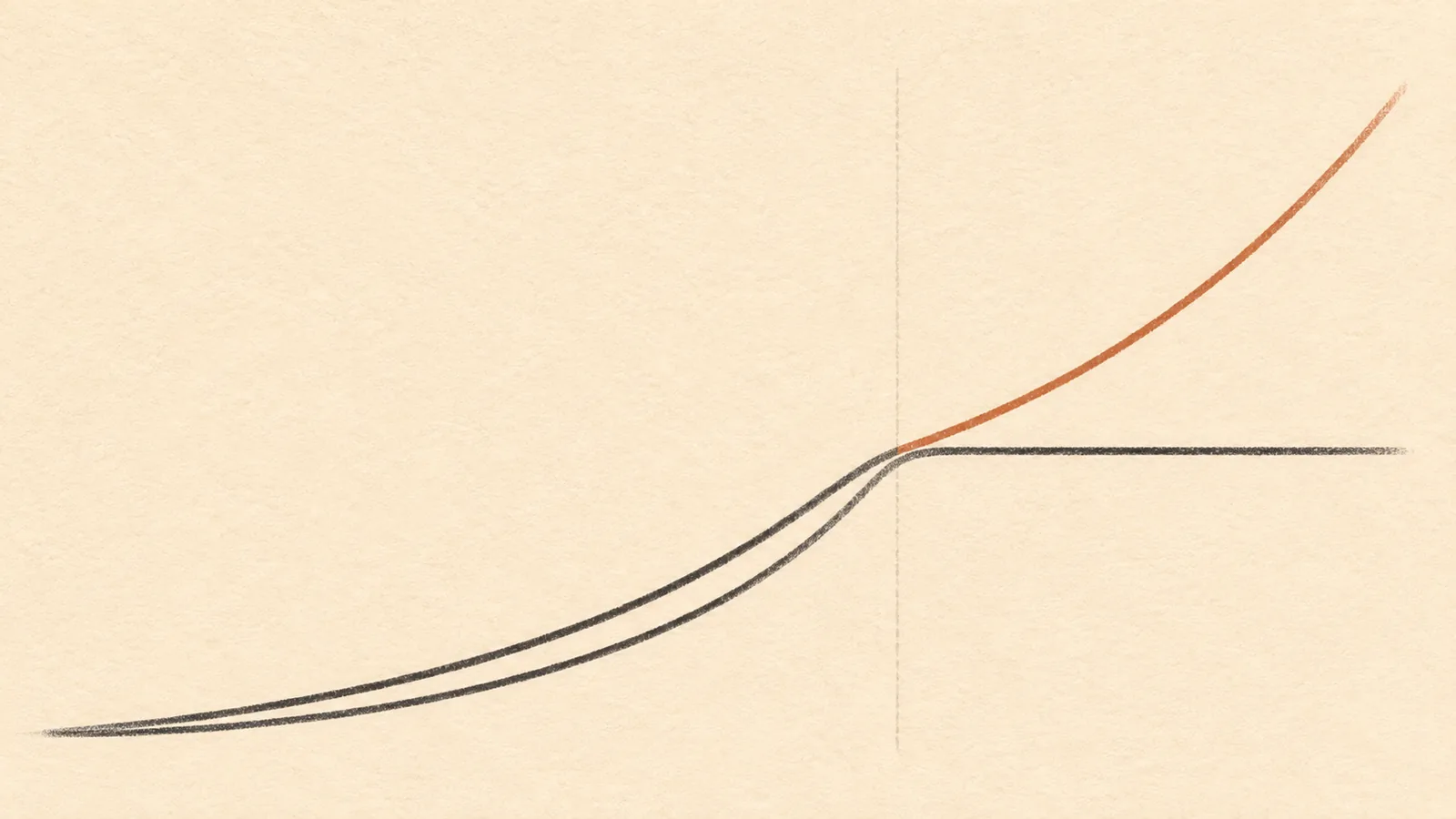
- Slope. Fit f(FLOPs) → performance below N. For each point past N, the slope is the p that makes f(N) + p·[f(FLOPs) − f(N)] match the observed score. A slope of 1 means scaling continues as if training had covered that budget, and 0 means flat. His hand-drawn Figure 1 shows the three cases (0, 0.5, 1) rising together to N and diverging after it, with no numbers on the axes.
He expects both to vary by domain. They should be higher where incremental progress is easy to recognize (math, offensive cyber) and should spread to new domains as models learn to discern fine-grained quality differences. That puts the method on the same axis as verifiability. Two distinctions he draws:
- Not the same as horizon-length generalization. Cotra's bio-anchors idea of training short and acting long is one form of compute extrapolation, since long tasks cost more compute. But extrapolation in loop count could improve short tasks without lengthening the horizon (Task Time-Horizon Scaling).
- Non-learned scaling does not count. Best-of-n, voting and external verifiers have no training maximum, so they always "extrapolate". Tillman sets them aside as "generally ineffective" because they need external verifiers and add no serial depth (footnote 4). This is opinion and it conflicts with this wiki's measured evidence. Wang et al.'s budget-matched test on Large-Scale Test-Time Compute has independent parallel sampling beating sequential refinement, and SwarmResearch has width beating depth on 4 of 5 tasks. Prefer the
empiricalresults for the domains they cover. His point holds where no verifier exists, which is the same caveat The Verifiability Thesis carries.
Consequences he argues (all practitioner-opinion)#
- The top of the capability distribution speeds up. Without extrapolation, a lab that wants a 10^24-FLOP answer at test time, such as a better ML algorithm, would first have to spend 10^24 FLOPs per task across many training tasks. Extrapolation removes that cost. His analogy is AlphaGo Zero: about 0.4 s of search per move in training, 5 s in one evaluation, and about a minute in tournament play, so a ceiling of at least 100×. He estimates that reaching the same strength without extrapolation would have cost 10–50× more training. That estimate is his own, not the paper's.
- Dangerous-capability evals lose their upper bound. Without extrapolation, an evaluator need only spend up to the training maximum per task (footnote 6 makes this conditional on best-of-n being weak). With it, ruling out a capability may need arbitrary test-time budgets. At best, an evaluator can certify absence below a stated budget, and can afford that only in a few domains. This is the mechanism behind Responsible Scaling Policy Evaluations' unbounded-budget gap and AISI's "a score is a lower bound". It also explains the cost result on Certified Test-Time Scaling Curves, where certifying the budget-K point costs on the order of K/ε however cheap the low-budget curve is.
- Compute races move from training to inference. If being first is valuable, as in AI R&D, it can be rational to spend millions of dollars of inference on an older model for a result a later model would deliver at 0.1–10% of the cost. He expects large inference "moonshots" and large sums lost on failed ones. This is the racing answer to Latent Capability Overhang's question of when to spend now rather than wait.
- It is evidence of better generalization in general. If RLVR across a 4-OOM band of task sizes generalizes beyond it, it probably generalizes within it too.
The evidence: one clean experiment, then circumstance#
Academic (open-weight, competition math). The Markovian Thinker (Aghajohari et al., 2025, arXiv 2510.06557; not in raw/; Figure 2b reproduced in the post and checked against the image at compile) RL-trains a 1.5B R1-Distill base two ways.
- Standard long-CoT RL gets a 24K-token budget. On AIME25 (avg@128) it rises to about 0.30 near 24K and is flat at about 0.304 through 128K.
- Delethink thinks in 8K chunks and keeps only the last 4K tokens between chunks. It is trained for at most 5 chunks and run for up to 30 or more. It is still rising at 128K, at about 0.347, roughly 5× its training budget, with no ceiling visible.
Approximate readings, which the post itself labels approximate: the image's y-axis labels are rounded, so they carry about ±0.003. Delethink is below the standard method under about 16K tokens, so extrapolation is bought with a small in-distribution cost at low budgets. Tillman adds that Delethink uses fewer FLOPs per training step. The supporting papers are relayed, not read:
- Reasoning Cache trains at 16K tokens and keeps improving at half a million.
- An end-to-end summarization paper reports the same shape for agents.
- E3 is the counterexample. It extrapolates without chunking, but only "2.5×", and finds several open-weight models gain nothing past their training length.
His reading is that context management is not strictly required, but that a Markovian loop is a good prior for extrapolation. On the agent side, the mechanism is the same object Working-Context Compaction Fidelity measures: a model that carries state across compactions without loss can keep spending.
Historical (frontier labs, explicitly circumstantial). No lab publishes N, so Tillman dates the onset by when models "seem to keep improving across an almost unlimited number of thinking and compaction cycles". Two dates:
- Anthropic, around Opus 4.6 (February 2026). On Epoch's MirrorCode, Opus 4.1 and 4.5 hallucinated time limits, while Opus 4.6 was still improving its pkl reimplementation at the end of a billion-token budget, after tens of compactions. In Toby Ord's reading of AISI data, Opus 4.5 needed 370× more chain-of-thought tokens to match a human's gain from 10× more time, and Opus 4.6 needed 46×. Both figures are relayed and carry large error bars. Neither Ord's analysis nor the MirrorCode post is in
raw/, though AISI's study is. - OpenAI, around GPT-5.1-Codex-Max (November 2025), advertised as "natively trained to operate across multiple context windows" via compaction. He calls the evidence ambiguous, because METR found compaction did not raise that model's time horizon.
He dates standard RLVR (o1, R1; late 2024) as showing little extrapolation, and puts the shift at around the end of 2025, partly behind the jump in researchers' compute spending at OpenAI and Anthropic.
What forced thinking in TasteVal does and does not show. In TasteVal, a scaffold that forbids stopping before 200k tokens makes Opus 5.0 statistically indistinguishable from Opus 5.5, at 42% more cost. That fits consequence 3: an older model, given more inference, buys roughly a generation of capability. Whether 200k tokens is past Opus 5.0's training N is unknown, so it is not evidence of extrapolation as defined here.
Multi-agent as the next extension (his weakest section, by his own account)#
Tillman expects swarms to extend both ceiling and slope. The extrapolation factor he gives is "10–1,000". It rests on OpenAI coordinating ~1,000 agents (the Hugging Face incident) and ~10,000 (Navier–Stokes) against a guessed training maximum of 10–100. He gives two arguments:
- Bounded-degree networks are self-similar across scale, and a single growing chain of thought is not.
- Wall-clock caps single-agent extrapolation in practice, while parallel agents scale over hardware.
Two things this wiki adds:
- Brown himself credits the 10,000-agent swarm with under 10% of the Navier–Stokes result, which Tillman acknowledges, and the single-agent counterfactual was never run.
- Brown's published plots show parallel agents trading efficiency for speed (four agents finish twice as fast at twice the cost). That is a wall-clock argument, not a ceiling argument. The wall-clock point does meet the pacing brake on Intelligence Explosion Dynamics: if extrapolation runs through parallel agents, inference duration binds less than Brown's June argument assumed.
Proposals#
Tillman's closing questions are policy proposals, not findings:
- Labs could publish their most compute-intensive training tasks per domain, as a baseline for measuring extrapolation.
- Someone should look for the first sign of extrapolation in algorithmic taste and ML research.
- RSI-likelihood assessments might need evaluations at $100,000–$1,000,000 per task.
The last one is the budget question Responsible Scaling Policy Evaluations leaves unanswered, now priced.
Connections#
- Large-Scale Test-Time Compute — the hub; this page splits its "capability is a function of budget" into the part training bounds and the part it does not
- Responsible Scaling Policy Evaluations — the unbounded-budget gap, given a mechanism: with extrapolation, no training-derived budget caps what a dangerous-capability eval must spend
- Latent Capability Overhang — extrapolation is what makes the overhang large, and the racing argument is one answer to when spending now beats waiting
- Task Time-Horizon Scaling — horizon-length generalization is one form of extrapolation; Ord's 370× → 46× token-per-human-time ratios are a relayed reading of the AISI data behind that page's budget-dependent horizon
- Working-Context Compaction Fidelity — the agentic mechanism: compaction is how Tillman thinks labs reached extrapolation, and CompAct-Bench measures how lossy it still is
- Experimental Taste as a Compute Multiplier (TasteVal) — forced 200k-token thinking makes Opus 5.0 match Opus 5.5, the shape consequence 3 predicts, with the training budget unknown
- Intelligence Explosion Dynamics — consequence 1 aimed at AI R&D, and a counter to inference wall-clock as the pacing constraint if the extra compute is spent across parallel agents
- Effective Compute Scaling — extrapolation decouples per-task test-time spend from per-task training spend, so the training-compute curve stops bounding the largest single tasks
- Certified Test-Time Scaling Curves — why no cheap run can certify a point past N: the cost of certifying a budget-K point grows with K
- The Verifiability Thesis — Tillman's domain prediction (high ceilings where incremental progress is recognizable) is this thesis applied past the training budget
- Forethought — publisher
Open Questions#
- What are the extrapolation ceiling and slope for any frontier model, measured against its disclosed 99th-percentile per-rollout training compute N? Settler: a lab technical report or system card that states N (or the maximum training thinking or compaction budget) beside a test-time curve run past it. Open-weight reports so far give only a maximum length (Nemotron 3.5, 80k extended to 128k).
- Does multi-agent scaling extrapolate further than single-agent compaction at matched FLOPs? Settler: an experiment that trains at ≤k agents and tests at 10–100k, against a Delethink-style single agent at the same per-task FLOPs, on one task family.
Sources#
- Two Kinds of Test-Time Scaling — James Tillman, Two Kinds of Test-Time Scaling, Forethought newsletter, 2026-11-09, ~4,700 words, two figures (
practitioner-opinion; conceptual essay; the historical evidence is explicitly "circumstantial"). Figure 1 is a hand-drawn schematic with no numbers. Figure 2 is The Markovian Thinker's Fig. 2b, read approximately; the y-axis tick labels are rounded. Every paper result, the MirrorCode observations and Ord's 370×/46× ratios are second-hand relays of sources not inraw/. Footnote 7 ends mid-sentence in the source ("DeepSeek's R1").
Cited by 12
- Forethought×2
Compute extrapolation (2026-11-09). Tillman splits learned test-time scaling into a kind bounded by…
- Intelligence Explosion Dynamics×2
Compute Extrapolation — test-time scaling past the per-task training budget, aimed at AI R&D: large…
- Large-Scale Test-Time Compute×2
Compute Extrapolation — this page's root claim split in two: learned test-time scaling that stops…
- Latent Capability Overhang×2
If cost falls 10–100× per release, when is it ever rational to spend big extracting a capability…
- Responsible Scaling Policy Evaluations×2
Compute Extrapolation — why the unbounded-budget gap has no training-derived ceiling: once a model…
- Task Time-Horizon Scaling×2
Compute Extrapolation — horizon-length generalization as one form of scaling past the per-task…
- Working-Context Compaction Fidelity×2
It prices the mechanism behind Compute Extrapolation. Tillman (practitioner-opinion) argues that…
- Certified Test-Time Scaling Curves
Compute Extrapolation — why a curve past the training budget is the expensive part to trust: if…
- Effective Compute Scaling
Compute Extrapolation — where the training-compute curve stops bounding the largest single tasks:…
- Experimental Taste as a Compute Multiplier (TasteVal)
Compute Extrapolation — the forced-thinking result read as an inference-for-generation trade: an…
- Model Capability & Training
Compute Extrapolation — Tillman's (Forethought) split of learned test-time scaling into two kinds:…
- Open Questions Backlog
Compute Extrapolation ×2 (oldest 1d) — What are the extrapolation ceiling and slope for any…
Related articles
- Large-Scale Test-Time Compute
Noam Brown's thesis that model capability is now a function of inference budget (tokens/cost/time): with good scaffoldi…
- Compute-Controlled Benchmarking
Noam Brown's critique: the single-number benchmark grid is broken because it ignores test-time compute — plot performan…
- Latent Capability Overhang
Noam Brown's claim that already-released models can do far more than anyone has extracted, because nobody spends enough…
- Task Time-Horizon Scaling
METR's measure of the task length AI can complete reliably on its own, doubling roughly every 4 months (up from every 7…
- Intelligence Explosion Dynamics
The growth-curve question behind recursive self-improvement: whether AI-accelerating-AI produces exponential, super-exp…